11/22/10

THE GREAT FIRE OF 1973


Unlike poor Mrs. O'Leary's Chicago cow, there is apparently no one to blame for the great 1973 fire at the National Archives and Records Center's Missouri cite housing its miltiary records. The National Personnel Records Center in the St. Louis suburbs housed veterans records for millions of men and women who had served their country in numerous branches and government work.


Only 20% of the Army records spanning 1912 to 1960 remained and only about 30% of the Air Force records survived from 1947 to 1964. Millions of records were destroyed ruining the chances of family historians, veterans, and others to access crucial validating records of service.


The lack of a clear cause (it was suggested the files had spontaneously combusted) left the field open for conspiracies aplenty.


For example:


The less than stellar performance of the government in exposing soldiers and airman to radioactive fallout after WW2 was just breaking in the news. With the threat of thousands - if not millions - of veterans falling ill with potentially related diseases...and suing the government...a fire was carefully engineered to erase the evidence.


The full military records of alleged presidential assassination, Lee Harvey Oswald, were also destroyed in the fire. This has fueled the fire for some conspiracy buffs. If his record supported some versions of the story they would implicate government and/or other collusion in the event. This could not happen so a fire was set.


What is known is that millions of Americans had to struggle to piece meal together records to verify service. Countless others searching for some small tibit of knowledge about a hero of a conflict in order to learn something of where they come from and what their ancestors did, were unsuccessful.
The individuals who found, retrieved, cleanup, and researched an alien craft (ala Roswell, NM) were on the verge of being discovered and so a fire destroyed the public records of this service while maintaining the private and classified records housed elsewhere.


Destroying, and endangering the lives of many people nearby, one file would unlikely have been the target.

The Great File of 1973 was a blunt force blow to the history of the men and women who sacrificed, suffered, and sometimes died for their country.

11/21/10

GONE - BUT NOT FORGOTTEN


A man who helped make Oklahoma City was it became was Charles Colcord. His lovely residence, 421 NW 13th,was built after he 'made it' in Sooner Land was truly impressive. Today, if this mansion were still standing it would be a major tourist destination, Hollywood would rent it for blockbuster movies, and people would point with pride at the rich heritage of their community.
Sources conflict as to the date of the building. A 1939 article of the Oklahoman says the house was built in 1903 (and has a photograph of the house being built). Wikipedia and the OK digital library indicate 1901. The Jan. 8, 1965 article in the Oklahoman, which shows the mansion after being assaulted by a 800 lb. wrecking ball, says the 11 bedroom house was built in 1901. The article was laconically titled, "Victim of the Times."
When Colcord built his historic downtown office building he leveled some early historic "shacks." The historic and lovely house in 1965 was torn down for the most noble of purposes, and probably one Colcord would have gladly accepted, to build a modern office building.

NEW PLAN TO MOVE COLUMNS


The lovely and majestic columns on the old Phillips campus in Enid, Oklahoma will be moved according to a new plan to open a Smithsonian quality museum addition in Enid adjacent to the Chisholm Trail Conference Center.
The current location, beside a peaceful pond with arching trees is lovely and in there place would be a destination for tourists, students, and community. The current plans show them moved to the new downtown addition and named for donors. In the fading golden sun of a peaceful November afternoon the thought of these gracious and classic structures being surrounded by traffic seems too harsh and cruel. They are mythic art so at home in their natural setting. Times change, places are forgotten or torn down. Another page of history is turned and what will the result of this urban renewal ultimately reveal? Only the future can tell if this will be a good thing or if , like so many other victims of urban renewals have learned, the realization will be that sometimes, stories and things, should remain.

11/7/10

UFO's IN HISTORICAL CONTEXT


Many people assume that the Roswell event was the beginning of reported sightings of unexplained things in the skies. An image said to be the first photograph of a unexplained object (what we call a UFO) is said to have been taken in 1870 New Hampshire (see other cases at http://en.wikipedia.org/wiki/UFO ).
Up to WWII sightings were made of what many claimed were metallic like objects shooting through the skies. In WWII both axis and allied powers reported a mysterious light and objects that they termed "Foo Fighters". In 1946 "ghost rockets" were reported in the skies of northern Europe. In 1947 - a month before Roswell sightings were made in the Northwest by a private pilot and over Idaho by a commercial airliner. Some even claim that such objects may be in ancient images and medieval drawings.
If the "UFO Craze", as some have called it, was soled birthed in the heady post WWII period, it would be a more clear-cut case and much easier to dismiss as mass hysteria related to the fear of the atom bomb being lobbed into our back yards by the "Commies". Although rationale, scientific, and contradictory explanations may emerge one basic fact remains: The fact that unknown objects had been reported 60 sixty years before Roswell....is a little harder to dismiss. Remember...just because you haven't seen something, doesn't mean it is not there....

UFO'S, ROSWELL, AND MYSTERY

Several years ago doing research for a social history project I explored the subject of UFO's...
Anyone who has delved deeply into the whole Roswell saga, has come across several names: Jesse Marcel Sr., Philip Klass, Karl Pflock, and ubiquitous kudos to one "Robert G. Todd". Robert Todd was, according to the late Phil Klass, the Grand Master of UFO Debunks, a “believer in his younger days", a "sharp-eyed researcher" who pioneered using the Freedom of Information Act (FOIA) to uncover information and who stated the USAF in its report data, possessed an "encyclopedic understanding of military records" (something hard enough for people with a strong military background - or, so military types tell me). Phil also said “Todd was the first – ahead of the Air Force and Karl Pflock – to discover the connection between Roswell and Project Mogul …Todd has since become so disgusted with UFOlogy, he has withdrawn from the field and discarded his files.” (--Gary Posner, email May 30, 2001)

Todd, along with Phill Klass and others, came to represent all the aspects of Roswell that caused people to say, “something doesn’t add up”. They symbolize the intuitive awareness felt by many that some things in the explanations simply did not add up.
The entire later half of the 20th century was comprised of a series of "preemptive hoaxes" apparently designed to undermine any possible valid information surfacing regarding UFOs or Roswell's famous crash. Consider for a moment, 1) Roswell begins to re-surface after several decades of being a faint rumor or totally forgotten and behold the MJ-12 documents surface and there is the haggling over its authenticity, 2) Roswell gains credibility through congressional investigations spearheaded by New Mexico politicians and the MOGUL explanation surfaces (aw, gee shucks, ma'am, I don't know how I forgot that top-secret project....), 3) yet Roswell continues to be considered seriously by too many people and the notorious "Alien Autopsy" film surfaces... even if this time line is off - search and you shall find the same "counter-moves" being made repeatedly to block potential credibility or serious investigation. Try it....you will find from the 1950's and the "Contactees", through the collapsing from within of major UFO groups (spurred by insiders for that very purpose some claim), to the whole smorgasbord of Roswell. A rise and fall of tide-like consistency, a dance of claim and counter claims serving to keep the whole subject the "fluff" of the evening news and the twinkle in every reporters eye ....

10/15/10

EARLY BUNGALOWS AND A WOMAN REALTOR


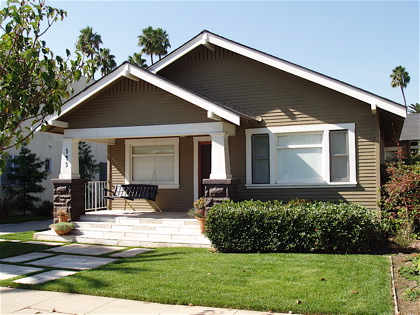
Several advertisements for 'bungalows' appeared in early Oklahoma City newspapers. They appeared to be centered in the NE 8th and NE 9th areas. The ads found (to date) appeared in 1907-1910. Several ads in 1904-1906 are being explored as well.


A 1907 ad described a bungalow for sale somewhere "near Emerson School" (715 N Walker area). In 1908, the ads were numerous and located houses on West 2nd, West 9th, East 7th, East 10th, 18th and 20th Streets.
An interesting sidebar was several of these were offered by a "Miss Corder with the Cowthorne Co." An early female real estate agent?
In 1909, larger "modern" bungalows were being advertised, such as the large home on 18th near Shartel, a seven room at 410 Maple on two lots, 705 W. 25th, 1441 W. Main, and on 26th Street.


In a 1915 edition of the Oklahoman, an article stated "100 Homes Built Here During Year: Bungalows Predominate as Type of Construction in Buildings". The hugely popular style was slated to reach 400 in the coming year due to its style, attentions to detail, and its price range of $12,000 to $40,000.
There was in the bungalow, quite literally, a style for almost every pocket book. It was the emergence of the American middle class and the "home ownership" movement that merged individualism, modernity (freedom from the stuffy Victorian styles) and a decidedly American equalization of status in society that made these homes real estate winners. Add to that in the coming years the "kit" houses, from Aladdin and Sears, that were easy to deliver, easy to build, and easy to buy and the stage was set for wide spread home building. "On Capital Hill, throughout the precincts of University and Putnam and other additions...their tile, slate, or shingle roofs cover comfort and inviting elegance."


The ubiquitous bungalow, so carelessly cast aside and denuded of its many charming and unique features is worthy of salvation through restoration. The bungalow, and the larger arts and crafts movement styles, were all designed and carried out with charming attention to creating an "atmosphere" of harmony, of integration of nature and art, and a space to feed the inner soul as well as protect the outer being .


10/11/10

'THE HIGHWAY MAN": A GREAT POEM FOR THE SEASON


I remember sitting in seventh grade English one warm autumn day as the teacher picked up the dogeared old text, flipped a page or two and then began to read aloud. It was a hard audience, right before lunch, and the students were slumped in seats or holding pencils over paper in anticipation of note taking.
Yet, as he read...the heat of the day fell away. The sun drenched institutional classroom became a dark landscape with a moon riding overhead. Our breathing quickened in time with the horses steps as a lover sped to a meeting and anxiety built in time with the frantic praying for safety in a young maid's breast. As the words rolled off the teacher's tongue we were transported to a far away place of romance and mystery...
"And still of a winter's night, they say, when the wind is in the trees,
When the moon is a ghostly galleon tossed upon cloudy seas,
When the road is a ribbon of moonlight over the purple moor,
A highwayman comes riding—
Riding—riding—
A highwayman comes riding, up to the old inn-door."
The evocative cadence and mood of the poem coupled with the reading quality made the poem an instant favorite. Alfred Noyes "The Highway Man" stands as one of the most mystical and romantic of poems I have ever heard. There is a pulse that runs through it as strong as a lover's heart beat and an echo of horses hooves carrying fate to its destination.
To this moment, a moonlight landscape can still evoke that memory. Then I swear I can hear the sound of distant horses hooves...riding, riding...

10/10/10

URBAN LEGEND LINGERS


CAREY PLACE (OKC)


In the early 1990's accounts of a "Hatchet House" with accompanying awful murder and porch painted red to hide "all the blood", began to appear in local OKC newspapers.
An axe welding murderer chases down a school girl, chopping her up and disposing of the body. Every house were she had sought help but found silence was then painted red as a mark of their guilt in the girl's death.

Soon tales of swings moving in the moonlight.....and ghostly voices of children playing..... began to flesh out the vague and lurid premise. Now, every Halloween local haunters flock to the historic district of the Gatewood Neighborhood to find the notorious house with hatchet cutouts...or the red painted porch....or the driveway where 'they found the body.'


This seemed like an easy find....track down the dastardly crime....solve the mystery...provide some background for this legend. Most versions seem to date the crime in the 1950's. Several other common urban legends do begin in the late 1950's and can be tracked in the news.
.
So far...however, no such OKC crime has come to light. The area only dates back to the 1920's when it boomed along with various other areas of the city. An official history document even dates it only to the 1930's. Its classic hometown feel and its historic homes kept it a special place for many decades. There was tragedy as children, going to and coming from, the local elementary school were killed in accidents. Some crime....natural deaths, but no murders. Findng a grim and ghastly crime worthy of such a horrific legend....has so far drawn a blank.

It is similar to the tale in the Don Knotts comedy, "The Ghost and Mr. Chicken." The small town with a haunted house, ghostly organ music and blood stained keys. Here, substitute the "Hatchett House" and generally bad reputation.

Unless, and until, something definite is discovered this is no doubt another OKC Urban Legend. So, drive through the area and enjoy the neighborhood that is on the national historic registry.....but give the folks there a rest because there is really nothing else to see there.

(Originally published 2008; updated 2013)

10/2/10

AN EVENING OF STORYTELLING FOR ADULTS


Let me tell you about...."Tellabration" (R) - A global celebration of storytelling held each November.

Each November storytellers around the globe celebrate storytelling in evening concerts in homes, halls, fields, theaters, bookstores, schools, and any place they can share their love of the art form. In 1988, a storytelling guild in Connecticut decided to offer a special evening of storytelling. It proved so satisfying that they planned more and soon they were happening all over the country!


According to one source, Oklahoma's first "TELLABRATION! (R)" was in 1992 at the Sooner Theater in Norman and was produced by Letty Watt. Over the years some producers have included: Letty Watt, Bob Bjorkland, Lois Hartman, Fran stallings, Lynn Moroney, Rosemary Czarski, Marilyn Hudson....

Some of the Oklahomans who contributed their talent to sharing stories in the state's many "Tellabrations!" include: Ginger La Croix, Letty Watt, Theresa Black, Robert and Marie Harris, Barabra McBride-Smith, Patsy Packard, David Titus, Weckeach Bradley, Jared Aubrey, Bob Bjorklund, Lois Hartman, Kris Hunt, Peggy Kaney, Sam McMichael, Jo Etta Martneay Bryan, Whit Edwards, Debra Garnejkul, Connie Fisher, Vance Morrow, Sky Shivers, Steve and Pat Kardolff, Will Hill, Tina Saner, Emilea Moring, Kathryn Thurman, Marilyn A. Hudson, Chester Weems, Rosemary Czarski, Liz Parker, Bonnie Smith, Jeannette Harjo, Stella Long, Shaun Perkins, Molly Lemmons, Kim Green, and others.

In the Tulsa, Oklahoma area Connie Fisher and Darla L'Allier have produced them at various locale venues, such as Borders Book Store.
Some sources for news of Tellabration events: Territory Tellers website, Oklahoma Tellers news blog, and the national page for the event.

Note: If you kow of other names or details regarding these events - please send them to me. The poster is from the 2002 event hosted by the Pioneer Library System in Norman, Oklahoma. Featured tellers: Lynn Moroney, Jahruba Lembeth, Maureen McGovern and Marilyn A. Hudson.

9/24/10

IT'S ALL MYSTORICAL: Have A Homeric Halloween?


In one of the world's oldest writings, The Odyssey, attributed to Homer in the 8th century BCE, there is an interesting scene of Hades with dark blood and pale specters. Interestingly, the ghosts are described as, ".. spirit, like a dream, flits away, and hovers to and fro" and elsewhere as "pale and wavering"......


In the midst of his struggle to return home, the hero sacrifices rams and summons one particular shade, but others come as well. They are drawn by the sacrificial blood and the life it represents...spectral moths to a flame of mortality. It is very interesting that this - so old a tale - contains some of the same motifs so common to modern beliefs of ghosts. The ability of the death's shade to move in non-human ways, to appear opaque, and to be drawn to those who can see them. Numerous alleged mediums indicate that this is a danger whenever people play with games or relics designed to contact the dead....the door is opened and there are no guarantees as to what may tag along.....


Surely, the vampiric legends also see their roots in this older image as well....the glistening, dark, rich blood that brings the dead like famished, thirsting wanderers of the dark desert of death.


Stories have always helped humans to describe, define, and decode the mysteries of their existence. People have always loved to gather to hear and share tales of romance, daring, and mystery. So it should not be too unusual that some themes and symbols become common motifs (what folklorists call archetypes) shared by culturally and geographically diverse peoples.
So, as the next season of ghosts and goblins appears, give a nod of the pumpkin juice to one interesting,and very literary forebearer, and have a Homeric halloween.

9/15/10

'ONCE UPON A TIME': A SHORT HISTORY OF STORYTELLING IN OKLAHOMA

Early native inhabitants had strong storytelling traditions as integral parts of their ancient cultures. Various immigrants since then have continually added their own particular flavor to the pot of story brewing on the campfires of present day Oklahoma.
It was a homegrown, rural, culturally specific or fading art across the country until the folk movement of the 1960's began stirring things to life and people rediscovered the joy of a story told well.
In the early 1970's in OKC the local libraries (in The Metropolitian Library System) were dynamic supporters of storytelling. They hosted events, trained volunteers, and went out into the community to introduce Oklahoma City to the art of oral storytelling. Many of the first storytellers who charmed audiences emerged from the ranks of librarians and staff within the system.


They were ready when a formal event to celebrate story emerged with the OKC Arts Council's "Wintertales" in 1982. "Wintertales" proved a popular event and grew to become a significant part of the year for storytellers, educators, and listeners across the mid-central regions. It developed into workshops, family concerts, and event concerts with nationally known and local storytellers. Always supported and assisted by the Territory Telllers of Oklahoma who held an "Olio" (story concert) and hosted a reception for the tellers and audience. The momentum continued even as a national event was being born in the event to be known as "Tellabration!" (R).


This "global night of storytelling" only began in the mid 1980's but by 1992 the state organization, The Territory Tellers, was going strong hosting events across the wider metropolitan area of Oklahoma City and in metro Tulsa. It was originally conceived as an event to raise awareness that storytelling was not limited to children and the programs celebrated "adult" storytelling by returning to the complex, socially relevant, and thought provoking tales that once enthralled people of every culture. Subject matter was approporate to adults with adult concerns, experiences, and dreams. In 1992, the event was held in the St. Luke's UMC. Local tellers included: Ginger La Croix, Theresa Black, Robert and Marie Harris, Barbara McBride-Smith, Patsy Packard, David Titus, Weckeah Bradley and Jared Aubrey. However, by the late 20th century the event had evolved to include "family friendly" events and "youth Tellabrations."


In 2003, Rep. Danny Morgan, then state storytelling agency president, Garland McWatters, and storyteller Bonny Smith asked Gov. Brad Henry to designste the week of storytelling (Nov. 16-22, 2003) as "Oklahoma Tellabration Storytelling Week!" Storytelling," Morgan said, " is a valuable method of sharing American folklore and is an important means of contributing to Oklahoman's knowledge of the history of our state."

9/8/10

HEADLESS IN OKLAHOMA: THE WORST CRIME IN YEARS


As a notorious trial was dragging on in 1907 Oklahoma City, a small kernel of news was mentioned in passing. The death currently in the news, so the papers stated, was the most dastardly and mysterious since 1899 when a man living about fifteen miles outside the city was murdered.


The lifeless body of German immigrant John Nulk, was found in about two miles in the country on Reno where that thoroughfare was more road than street. Nulk had been a pioneer of the county and had come from Richardson County, Nebraska. The federal census lists several people of that name in several northern locations.

Just six months before the Nulk case, along the Canadian river, a headless body had been found by men fishing. The murder site was located to have been southwest of the city near the Wheeler Bridge along the banks of the river. After a further search, a head with a bullet hole was found in a pillow case and identified as a local man who repaired shoes in the City, an A.J. Eick.
These locations were the site of many apparent body dumps from just before and after statehood. Convenient to transportation hubs and numerous individuals able to move about without notice. The wild and bad old west was not too distant a memory despite the dawning of a new century.

Detective work had identified several individuals as the guilty party and they were all reported to be in a Kansas penitentiary, although one man was accused of being the actual killer he was never charged.

9/7/10

UNDISCOVERED COUNTRY: PENTECOSTAL HISTORY IN OKLAHOMA, KANSAS, AND TEXAS


Sometimes history is putting together two perspectives in order to gain true focus on the past. The larger histories of the areas of Oklahoma, Kansas, and Texas are well covered in myriad works. The larger histories of the Pentecostal Movement of the 20th century is well known and covered in numerous important works. What is lacking sometimes is the overlap that brings a spotlight on to what was happening in this place, at this time, in these areas.

As part of a larger research project, I began to piece together a timeline (something I had not seen in any of my research) and this has been very illuminating. It is not finished, it may never be finished, because other fragments of history may lay undiscovered in an attic or an archive. Someone looking for 'A' often overlooks the 'B' and 'C' which can provide better context, meaning, or examples of an event.


Pentecostal Timeline: An Annotated List of Instances in Kansas, Oklahoma, and Texas
Compiled by Marilyn A. Hudson
In progress since August 27, 2010

1890-
Deleware, Ohio Daniel Awrey receives the baptism of the Holy Spirit and speaks in an unknown language (some sources question this).

1895 –
Reports of possible Pentecostal experiences in Iowa, Nebraska or Kansas.[ Martin, Larry. The Life and Ministry of William J. Seymour.” Joplin, MO: Christian Life Books, 1999.pg. 26]

1900-
Charles Parham speaks with a member of the FBHC discussing a spiritual baptism with tongues; this turns his attention to assigning his Bible College students to explore the scriptures over Christmas break.

1901-
Topeka, Kansas, Bethel Bible College, Agnes Ozman is the first of several students to speak in tongues in response to their study and prayer over the holiday break. [Synan, Old Time Religion, Advocate Press, 1973,pg. 92.; ]

1902-
Lamont, OK FBHC convened its General Council Meeting in the church at Lamont, Ok. This church was the one and only church in the FBHC work in Oklahoma. The conference, or state association as it was known, disbanded until Sept. 1909 when it was reorganized.
Fall – Galena, Ks evangelist Charles Parham arrived to preach the “Apostolic (now Pentecostal) teaching.” (Goss, pg. 11). A Mrs. Arthur was healed of blindness and people spoke in ‘tongues’.

1903-

1904-
“Saloon Was closed Up by An Order of Court”, The Oklahoman (Jan. 22, 1904):9. Charges by a grand jury investigating corruption in city government were served to the owner of the Blue front Saloon, Dick J. Cramer
“Jack du Bois choked a Boy”, The Oklahoman (Dec. 24, 1904): 5 About 8 p.m. one night local drunk Jack du Bois, was assaulting and choking a 12 year old boy, Joe Dishman, behind the Blue front Saloon and was arrested.
Parham holds a revival where people from ‘Carthage, Missouri to Miami, Ok’ accepted the ‘full gospel’ (Burke, pg. 17)

1905 –
Howard Goss holds a Pentecostal revival in Tahleqah, OK (Burke, pg.17 – who suggests it was OK’s first Pentecostal church)
Pentecostal revival at Billings, OK led by Harry P. Lott and an unnamed Free Methodist minister.
Summer, Parham takes 24 people to Houston, Tx to open a work. He left in charge of the Galena, KS Assembly Mrs. Mary Arthur and Mrs. Fannie Dobson.(Goss, pg. 29). In Houston, ‘called to the Lord’s work’ were Rosa Cadwalder. Hattie Allen, Millicen McCLendon.
African American Lucy Farrow, receives the baptism in Houston and feels called to go to LA; Parham provides the fare.(Goss, pg. 35).
The lady workers did not wear uniforms but the current fashions of the day “silks…satins…jewels or whatever they happened to possess.” (Goss, pg. 38)

1906-
 Jan. 18, Richard Beall and Oscar C. Wilkens appear in OKC to start a mission work, start with a Sunday School on S. Robinson ;
 An African-American restaurant, Haynes Café, is located at 7 West Grand Avenue. In May edition of the Oklahoman there is a small news report of a fire that broke out in the middle of the night from an overheated stove. “Last Night’s Fire”. Oklahoman (May 9, 1906):5.
 Beulah Holiness School, or Emmanuel Bible College, established (Clancy, Bryon. The history of Beckham County. Accessed at http://files.usgwarchives.org/ok/beckham/history/carter.txt; Burke pg. 18 says it was 1907). Established by a group of Holiness people called, ‘The Indian Creek Band’ settled a community they called Beulah and there established a Bible school to teach holiness. Reports were it was a three story brick structure near a Baptist Church and they mailed a newspaper, Apostolic Faith, out nearby Doxy, Oklahoma.
 Asuza Street revival starts in the spring in L.A. (Martin, pg.165).
 George G. Collins, one time farmhand for the 101 Ranch in Oklahoma is ordained at Azusa Street (date unclear) (Martin, pg.13).
 A Reverend Cook, who had been in California at Asuza street now comes back and goes to Lamont to conduct a Pentecostal revival.
 A ‘group of workers’ was sent to Wallis, Tx in 1906 (Feb) and they included Nora Byrd, Mabel Wise, Millicent McClendon and Hattie Allen (later Obermann) (Goss, pg. 41)
 Visiting ministers came to help the new work, including Fay Carrothers, Mable Smith-Hall, Mrs Annie Hall and others…

1907-
 Feb. 6 Harry Lott, Beall & Wilkins rent the Blue Front Saloon, 7 West Grand, for $40 a month [Muse papers; Campbell; Harold Paul]. The saloon was located on the edge of the wild center core of the city, known as OKC’s “Hell’s Half Acre”. Today the area between Santa Fe and Broadway and Sheridan to Reno is largely known as the area of the Cox Convention Center (the old Myriad Convention Center), a hotel, and the turn off into Bricktown. "Back in the day" this was the wildest place in the newly opened "Oklahoma Town" or "Oklahoma Station" ("City" did not come about formally till nearly forty years after the 1889 land run). It was so wild it earned - through blood, sweet, and tears - the nickname "Hell's Half Acre." If you stand on the platform of the Amtrack station and look west and slightly north that is where this wild town within in a town was located. If you walked west on Sheridan (called Grand back then), just past Santa Fe (called Front then) on the north would be "Bunco Street" with its gambling halls and con men. Look south and there would be "Hop Boulevard", perfect if you were thirsty. And just behind that, "Alabaster Row" was located on California, featuring brothels, gambling halls, and other businesses for the African-American population in those days.Walk up Santa Fe (Front) to Main and turn west and you would see a bit finer offerings with The Arlington and, in 1900, the Lee Hotel at the corner of Main and Broadway. Turn east and across the tracks and there were the depot and just beyond to the northeast "Old Zulu's" original brothell/saloon establishment in current Bricktown. Travel south to 312 E. Grand and you would have seen the spot of "Big Annie" Wynn's original land run tent brothel. It had grown into a two story building, and moved a few blocks east, by statehood. From at least 1902, a walk up Broadway (into the 100 to 300 blocks) would have found "fortune-tellers', "crystal ball gazers", "clairvoyants", "mediums", and "pyschics". All world traveled and well known, or so they said as they advertized their stay in the parlors of local hotels and boarding house along the street. [Hudson, M. Mystorical accessed at www.mystorical.blogspot.com]
 In this setting the work begins in Oklahoma City.
 Mary A. Sperry, a local woman, opens her home for ‘tarrying services” (Campbell, Pentecostal Holiness Church history)
 Irwin opens church in El Reno, OK (Welch, pg. 36]
 May 1907 JH King holds a FBHC revival in Lamont, Ok [King, Yet Speaketh, PHC, 1949, pg. 127, he had received his baptism just the previous February];
 Summer there is a revival at Beulah under once Nazarene and now Pentecostal minister Robinson. 1st person to receive baptism there was an elderly woman named McClung (Campbell 210-211). Daniel Awrey goes to Beulah this year also as the Emmanuel Holiness Bible College Bible instructor and then principal. That summer the Pentecostal experience is said to have arrived at the school. Dolly and Dan York go to Beulah where the “Pentecostal folk” were .[One nightclub]
 August, Beall, Lott and others are reported to have received ‘their baptism’ [Paul, pg. 12]
 As a result of these events, the FBHC reestablished its presence along with independent Pentecostals and churches were started in: Yukon, Billings, Drummond, Perry. Pawnee, Muskogee, Mazie, Witchita, McAllister. Quinton, Cowen. Hart. Stratford Paul’s Valley, Castle, Swan Lake, Manitou, Faxon, Tipton, and in KS<>
 Lott organizes the OKC Mission aka Blue Front Saloon Mission into the FBHC. Oldest organized church in the OK Conference and one of the oldest Pentecostal churches in the Midwest
 Nov. well known and colorful figure of “Old Zulu” aka Martha Fleming, a notorious OKC madam, prostitute, pick-pocket, and addict received salvation and was the next day baptized in the local river. Although, she appears to have later renounced her conversion, it is extremely interesting that in a day and age when Oklahoma and the nation was extremely racist, that an African American was welcomed into a mission service at the Blue Front Saloon Mission. This is extremely telling of how wide-spread the Azusa ethos might have been and the value racial and gender equity was esteemed in the early days of Pentecostalism. [McRill, A. Satan Came Also, 1955. pg. 4; Paul, p. 13]
1908 –
 Dan and Dollie York rec’d Pentecostal baptism summer at Foss under F.M. Brittain, FBHC
 JH King holds revival at Synder ;
 Harry Lott named ruling elder of the FBHC in Ok;  Beulah School becomes fully Pentecostal.
 “Blasphemy and Gun Play Enliven Church Service” The Oklahoman (Nov. 10, 1908):10. Services disrupted at the “Pentecostal mission, 7 West Grand Avenue”, pastored by Harry P. Lott
 Parham holds a revival in Tulsa, OK on the corner of 3rd & Cincinnati (Burke pg. 23) Out of that grew the oldest AOG congregation in OK<>
 Waurika has services led by Archie and Pearl Adams (Burke 24) 1909 –
 September F.M. Brittain comes to Oklahoma to reorganize the FBHC in the state. Agnes Ozmen LeBerge is one of several women listed as ministers
 Pentecostal revival breaks out in SW ok with Oscar Jones at Frederick
 Daniel Opperman preached in Tillman in Manitou (famed evangelist) (Burke pg 28)
 “Minister’s Wife Restrains Him”, The Oklahoman (Sept. 29, 1909):4, Lott’s wife Emma, filed a restraining order citing assault and lack of support. Lott, made $75 a month pastoring the German Holiness church (not sure if this is a typo or another congregation, cites rescue home at 300 Maple street His church is identified as located corner of Hudson and California, which would mesh with the 317 W. California address of the “First Church.”
 “Minister fined, sent to a Cell”. The Oklahoman (Oct. 3, 1909): 31. Harry P. Lott, supt. Of the Pentecostal Rescue Home for Fallen Women, 300 West Maple, OKC. Numerous newspaper accounts up to this time period underscored the challenges young women faced in the big city. In 1910, Shawnee, Oklahoma a 19 yr old Pierce Hammack, was jailed because his actions seemed consistent with "white slave traffickers". Hammack said he was employed by the Franklin Theatrical Company and either for them, or his own side line activity, he solicited girls through "mind reading" and "fortune telling". In an earlier incident from 1902, a Kansas father chased a "voodoo man" - a fortune-teller and/or magician - who he claimed had enticed his 15 year old daughter away in a similar fashion. Between 1903 and 1910 numerous incidents appeared in local Oklahoma City papers of girls met at the train depot and offered "jobs" as maids at local "hotels". The establishments, they soon learned, were staffed by working girls. Some were drugged, raped, and intimidated into staying. Some, because of previous abuse at home from family or friends, simply had no heart to move on. Others, were successfully "rescued" through various religious and social efforts. [Mystorical]
 October, Blue Front becomes the “First FBHC of OKC”
 Pentecostal services in Lee School , Muldrow, (Burke 29) 1910-
 Lott appointed ruling elder of the FBHC;
 Mary A. David appointed to a church in Manitou, reflects the role of women in the early days of the FBHC,
 “Divorces Given to Three Wives”, The Oklahoman Jan. 28, 1910): 12. Emma Lott granted divorce from Harry P., they had married in 1898 in Longmont, CO. He is described as being a pastor ‘’for the holy rollers.”
 Mary Bernice Ferguson, of Beluah headed to east oklahoma where she preached by wagon, horseback in places all around Stilwell (Burke, pg.29) 1911-
 FBHC and the PHC merge in Falcon, NC, January.
 August 30, the new Pentecostal Holiness Church convenes in sessions at the Capital Hill Park Camp under the oversight of Harry P. Lott (Paul, Harold. From Printer’s Devil to Bishop, Advocate Press, 1976, pg.16; Minutes of the Third Annual Session of the Oklahoma Pentecostal Holiness Church, pp.2-3]. Ministers listed included several women: Miss Mary K. Davis (later Shannon), Dolly York, Agnes La Berge, Pearl Burroughs. And Annie Aston (Campbell, pg. 214).
 The conference boosted 25 churches or mission stations, 17 pastors, and 12 evangelists. 1912- Arkansas evangelist Powell Youngblood invited to bring Pentecostal message to Turkey Ford, Delaware count 9Burk pg 29) 1913
 May 1, 1913, future bishop Dan Thomas Muse attends his first Pentecostal Holiness Church meeting, held on the street at the corner of Grand and Robinson in OKC. He subsequently attended ‘the mission’ and received his baptism [Paul, pg. 22]
 PHC Convention held at Delmar Gardens; W.D. York gains approval to start a school at Stratford (One nightclub)
 Ethel Musick preached her first sermon at age 17 at the Payne Schoolhouse, west of Duncan (long time AOG evangelist ) (Burke pg 28)
1915
 Wagoner Literary Bible School {one night club) 1916-
 General Overseer of the Church of God Roy Cotnam 1917
 Harry P. Lott founds the Capital Hill Full Gospel Church. It was first the Apostolic Faith Church and in 1924 it was the site of a conference of the wider Apostolic Faith Church. 1920
 -General Overseer of the Church of God John Burk
 -First PHC Sunday School Convention held in OKC [Paul, pg. 43] 1924
 Kings College, Checotah, Ok 1927
 Monte Ne, Ark Ozark Industrial College 1927
 Kings College, Kingfisher 1946
 Southwestern Pentecostal Holiness College, OKC


SOURCES:
Burke, Bob. Like a prairie fire: a history of the Assemblies of God in Oklahoma. OKC: OK Council of the AOG, 1994.
Campbell, J. The Pentecostal Holiness Church, 1898-1948. P.H.C. Publishing, 1948.
Conn, Charles W. Like A Might Army. Church of God Pub. House, Cleveland, TN, 1955.
Hudson, Marilyn. “Mystorical” accessed at www.mystorical.blogspot.com; When Death Rode the Rails with Tales from Hell’s Half Acre (2010).
King, J.H. Yet speaketh. P.H.C. 1949
One Nightclub and a Mule Barn: the first 60 years of Southwestern Christian University. Tate. 2006.
Paul, Harold. Dan T. Muse: From Printer’s Devil to Bishop. Advocate. 1976.
Synan, Vinson. The Old-Time Power: a history of the Pentecostal Holiness Church. Advocate Press, 1973.
Welch, Kristen Dayle. ‘Women with the Good News’: The rhetorical heritage of Pentecostal Holiness Women Preachers. CPT, 2010.


9/6/10

MY LIFE IN LIBRARIES, PART 1


MY LIFE IN LIBRARIES, PART ONE: THE EARLY YEARS
by Marilyn A. Hudson

Part 1 – The early years

The first library of my life was a simple mission style book case in the living room containing the only books in the house; the crimson bound set of the “World Book Encyclopedia.” I loved going through that set with its drawings, lithographs, and colorful overlays. There was an overlay of a frog showing it from skeleton to flesh and one of the human body; which I found to be very insightful. For years I imagined our insides stacked with clear sheets containing nice flat organs and bones.


I really loved those books and as I learned to read, they were an amazing source of explanation. I would watch an old movie on television and want to learn more about airplanes, the French Revolution, or atoms and head to the shelf. Sitting cross-legged on the floor, I’d start with the answer to my question but then find I had read whole other sections as well.


The first time I was in a public library I was in the third grade on a field trip. In our small town, the library was not for just anyone. It was an old Carnegie building with dark, moody oak and arts and crafts furnishings, ringed by tomes weighty and well endowed by time. A shrine to knowledge victorious over ignorance, and the elite to whom such mysteries were made available, it was a holy of holies accessed via a steep set of stairs. Climbing those stairs always brought images of entering a palace, climbing a scaffold, or ascending the steps of a Mayan temple as the next virgin sacrifice – depending on the mood of the reason for going that particular day. It was the product and hobby of local aristocracy, leading members of society, and their offspring. All others were well aware of the largess that allowed the plebian masses to also enjoy its benefits.


The children’s room was an added feature, not part of the original plans, and as far away from the library general as possible. It even had its own side entrance. I remember it was a dreary day and the yellow shelves could only brighten the room so much. There was a nice neutral and bland tan carpet, white walls, and some spots of warm wood in rocker and a desk. It was not a children’s area – but a restrained adult image of a suitable space for children engaged in appropriate activities to educate, but not stimulate, the young mind.


The next library of my life was in an elementary classroom in school. A long metal shelving unit, with sliding doors ran under the large windows. Inside were secured the drawing paper, glues, scissors, and in one section two shelves of books. They were old books, well worn, and somewhat abused. Cast off text books, literature, poetry, and novels they were available to just anyone who wanted to read them. I read the many amazing adventures of a boy and girl and their dog in short, easily managed sentences. Then I moved on to a story of a small Martian who arrived in an orchard and had adventures with the little boy who lived on the farm. I read of a horse that raced across cool meadows and ended up blinkered pulling a milk wagon. I read of faraway places and local history.


Then, however, came the library in Junior High. A large room on the third floor, northeast corner, of an old red multistoried school, the library was a magnet. Warm oak shelves, tables, chairs and wooden blinds as old as the school created a welcoming aura. I wandered those aisles, thumbed through the card catalog, and nibbled at every crumb dropped my way in class, in a book, or from the world around me. I was not a good student in those days. I was too unsure, insecure, and easily intimidated by those around me. In the library, though, I was reading Dumas, Virgil, and other classics in the sixth grade. I would take the later bus home and stay to finish my class assignments before checking out books to read on the bus: The Three Musketeers, Sherlock Holmes, Edgar Rice Burroughs, Shakespeare, Ivanhoe, The Rise and Fall of the Roman Empire…


Strangely, I must confess, I do not remember if there was a librarian there or not. I think there was a woman of indeterminate age and shape who revealed to me the mysteries of the card catalog, the layout, and the borrowing process. Sometimes there was an older student who listlessly checked the books out to me, but usually my head was down, focused on the new treasure in my hands, and I did not notice such trifles.


It was enough that the priceless and endless bounty of the temple of the library had been opened to me.

(M.Hudson, 2010; Permission to reproduce is given, if credit line is included)

8/24/10

THE BLUE FRONT SALOON AND MISSION


The Blue Front Saloon was located at the corner of Grand Avenue and Santa Fe (7 Grand Avenue) in downtown Oklahoma City.
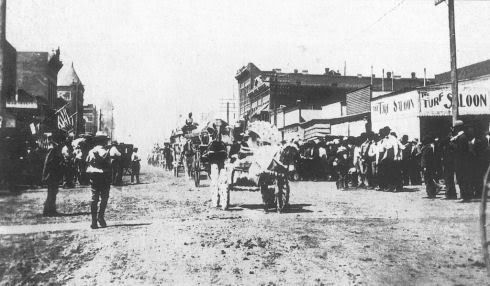
When it was established has yet to be discovered. It was mentioned as a wild locale in a newspaper account dated 1904. It was well known as a part of the rowdy "Hell's Half Acre" of Oklahoma City. Gunplay, gambling, prostitution and crime were rampent. The area had swiftly developed from its founding in 1889 and the town was filled with brick and morter structures within months of its birth. The saloon was described as being fronted by broad windows normally covered by blinds. The image shows an Oklahoma City street scene Easter of 1900 (linked from original source).
In 1904 a holiness school was opened called the Beaulah Holiness School in the area of Becham and Carter counties. 1905 a group called the Fire Baptized Holiness Church, under the direction of J.H. King held a revival in the Lamont area. In that year, a group in Billings held a service where several people were baptized in the Holy Spirit, spoke in tongues, and frightened many of the people attending the service!
In 1906 a revival began in far off Los Angeles that would have a direct impact on the life of many in Oklahoma. An African American holiness minister would begin a series of services in an old warehouse that would cross denominational, gender, and race lines in promoting a spiritual experience bringing the Book of Acts alive to a new century. These people sought redemption and experienced signs and wonders akin to the Biblical examples. People from across the nation who had been ardently seeking deeper spiritual experiences when to California to see first hand what was happening there. Some were shocked and left and others were certain that as Amie Simple McPherson would later say, "This is that", this was the experience the prophets had foretold. Those believed spilled out across the land sharing the vital new message of renewal and renewed spirituality.
In 1907 the notorious but now closed saloon was leased by two Holiness ministers and became the Blue Front Saloon Mission. In August of that same year the two men, R.B. Beall and O.C. Wilkins received what was known as the 'baptism of the Holy Spirit' and spoke in other tongues. It then became one of the first pentecostal churches in the central United States. Although no known photo of the saloon has been found, it may have looked like the saloon in Carnegie dated at about 1900. Unidentified photo.
In about 1907-08 it was being pastored by Rev. H.P. Lott. He had been in a revival in Billings, Ok in 1905 when one of the earliest recorded instances of speaking in tongues and the classical Pentecostal experience occurred in Oklahoma. Under Lott's leadership the mission expanded to include a rescue home for 'wayward women'. This was a common outreach by churches and civic groups in a time when girls and women were often seduced and abandoned in a society that was often unforgiving of such falls from a moral high ground. The local prostitution business also sometimes used deceptive means to renew their 'stable' of workers. Young, naive girls coming to the city for the first time were often easy targets to lure into the trade or to assault and coerce into working in one of the houses or, as they were coyly called, 'resorts.'
Some Sources:
McGill, Albert. Satan Came Also. 1955
Paul, Harold. Dan T. Muse: From Printer's Devil to Bishop. 1975

8/22/10

THE AWFUL HORROR THAT WASN'T


Nearing 1910, there was great fear as a comet was set to pass by the planet in its 75 year journey around the sun. In the past, its passing had been magnificently fearsome, and prophets were sure this would be a terrible and awesome event as well: Halley's Comet.


It also allowed for warped humor to rise to the surface to sell newspapers. A newspaper writer in New York printed a story of horrible and savage ceremonies in a far and exotic location: in Colorado and eventually morphed to have occurred near Aline, Oklahoma.


The exotic drama included a beautiful maiden, human sacrifice, a daring adventuresome Sheriff riding to the rescue, and wild eyed fanatics under the spell of some ancient god as the time of the comet drew near.

I ALWAYS WONDERED ABOUT THAT


There are so many conveniences we take for granted most of the time. Things like walks. In areas where natural rock was sparse or non-existent, how did people create walkways through muddy yards or get from point "A" to point "B" without slogging through ankle deep mud. The answer was revealed from a photo simply identified as having been taken in Guthrie, Oklahoma ca. 1900. The "walk" up to the front porch and around the side of the house was created by lengths of lumber (from the size perhaps as long as 12 feet, 2 inches deep, and perhaps 8 to 12 inches wide in some places). Note the pride of place for the bicycle as well.

8/17/10

Daring Japanese Girl Spy - 1904


In 1904 a story came out of Japan about the 'daring exploits' of a Miss Ando Yoshi. In a dangerous move , and with great personal risk, she stole important war maps held by the Russians in Port Arthur and wearing a disguise stole across the vast Russian countryside to make it to "Peking". The maps outlined defensive positions and plans along the Manchurian boundaries where Russian forces would be moved in an offensive strike. Although a poor girl, she did not wish to become a geisha, so instead worked hard to earn a living making and selling rice cakes. News that a good living could be made in Manchuria - she went there. She sold first to Japanese residents, then to Chinese and then to the Russians. Many suspected after the fact that it had been her glossy black hair and "bright eyes" that "played havoc" with the Russians, who favored her in the selling of rice cakes. This boom in business provided her access, knowledge and opportunity once she learned of the maps and their intent. Source notes indicate the story originated from the "New York Sun".

MUM IS THE WORD

Several legends exist about the supposed mummified remains of John Wilkes Booth residing for long years in the attic of an Enid store and strange mummies found elsewhere with bizarre features or anomolous surroundings. Sometimes the stories are true underscoring the fact that truth can be the strangest of all.

Occasionally, one hears of strange things have been done to bodies. People preserved and kept in the company board room, or kept on display as a sample of how good the embalming job at XYZ frontier funeral parlor. bad men killed while robbing a bank were often put on display and as late as the 1930's the bodies of Bonnie and Clyde and their henchmen were displayed as stark lessons to any who contemplated fighting the law.
There is a story that one Elmer McCurdy, outlaw, alias Frank Curtis and Frank Davidson. It is said "he was killed during a robbery by a sheriff's posse near Pawhuska, Oklahoma, on October 7, 1911. 66 years later, his mummified body was found in a fun house attraction at the Long Beach, California Nu-Pike amusement park. It was during the filming of an episode of TV's "Six Million Dollar Man," that a technician rearranged what was thought to be a mannequin, only to have one of McCurdy's arms fall off. Elmer is now buried here in 1977, under 2-1/2 yards of concrete. May he rest in peace; even an outlaw deserves that respect.

7/30/10

THERE'S SOMETHING IN THOSE OKLAHOMA HILLS

NOTE CORRECTION TO EMAIL: From the producers "the email address for Boggy Depot Bigfoot Conference is boggydepotbigfoot@aol.com not yahoo" -- They just got the website up you can stop by at boggydepotbigfoot.com - We hope to see you at the conference! "

In the early 1960's, keeping pace some said with tales emerging out of the Pacific Northwest, stories begin to surface of strange critters roaming the river runs and forests of Oklahoma.

El Reno Chicken Man. Oklahoman (1970 Dec pg?). Original article not yet found. Mysterious tracks located around a chicken coop that had had its door pulled off [cited in “Monster prints called fake”].

Lawton alert for “wolfman.” Oklahoman (1971 Mar 3 pg 46).The “thing” described in this AP story as traipsing around this southwestern corner of the state as being “tall, very hairy, with a distorted face and wearing pants several sizes too small.” Moreover it was alleged to be able to jump 15 feet from a standing start or drop from a second story balcony with out ill effects. C. Edward Green, 24, was a witness and declared it was no hoax. He described its ability to jump, said it was heavily bearded with extremely thick, black hair all over its body. Donald Childs, 36, suffered a seizure when it sprang out of a nearby field, leap a fish pond, and “really move out” toward an alley. When first seen was simply sitting in a flower bed near the pond. Unidentified others, including three soldiers from Ft. Sill, reported sighting it as well.Monster prints called fake. Oklahoman. (1972 Jul 26 pg 21) by Cecial Peaden. The director of the OKC Zoo, Lawrence Curtis, and Hayden Hewes, director of the International UFO Bureau in Oklahoma City, gave their opinions on a set of tracks from a Louisiana, MO sighting (by Edgar Harrison’s son and daughter) that had people in two states puzzled. Zoologists from the University of Missouri declared it was not a bear but could not say what it was. The creature seen making the tracks was described as “tall, hairy creature”. Hewes leaned toward a “visitor from a flying saucer” and Curtis of the zoo declared they were probably fakes. However, black hairs were found around the print and were being sent to Oklahoma for analysis.

Experts to join search at Noxie. Oklahoman (1975 Sept 9 pg 28.).A group of researchers with Hayden Hewes, associated with the Association for the Investigation of the Unexplained, descend on a small community southwest Oklahoma near. Hewes reported about a dozen sightings had been made of a “hairy seven-foot monster” with “eyes that glow in the dark” had been reported in the area since 1972. Armed with cameras, tape recorders, and a Geiger counter they planned to search for evidence.


State’s own “Bigfoot” topic of talk. Oklahoman. (1977 Jun 4 pg 9). Bob Stamps of The International Organization for the Unknown presented a talk at the Edmond Broadway Motor Inn. He reported sightings from the NE corner of the state and shared alleged tapes and films of the “Bigfoot” creatures.Sasquatch send sooner…. Oklahoman (1977 Aug 7 pg 200).Story by staff writer Robert B. Allen “somewhere in northeast Oklahoma”, along researchers Mike Williams and Bob Stamps investigate the “fabled, hairy monster of Big Timber Hills”. An OKC psychic, Charles O. Rhoades, had led a group into the area where he as “confident" something would be found.


Mysterious Creature Stalk….Oklahoman (1977 Aug 10 pg 33). From Stilwell, staff writer Jim Etter reported that a teenager had been clawed by a “hairy nine-foot-tall “something” with “glowing red eyes” in wooded northeastern Oklahoma. Adair county Gary Faden had confirmed their investigation being kept low key to prevent a panic and people getting “guns out there and getting someone shot.” Reports indicated the creature “stalks in the moonlight, peers through windows with its red eyes, grunts like a hog and bounds off…


Lie-Detector….. Oklahoman (1977 Aug 8 pg 240). Jim Etter continues with an account of a Colorado private detective who ran a “psychological stress evaluation” lie-detector test on statements made by 17 yr old Brian Jones about his story of being attacked by a hairy creature. The youth had reported to authorities he had made the story up and had lied during a polygraph test in Ft. Smith, Ark. The Colorado detective, Forrest Erickson (Wheat Ridge, CO) said that it was his opinion the boy had told the truth and his test bore it out. “I really believe the boy’s telling the truth…I can’t believe that he’s not telling the truth.

"Search for “Big Foot.” Oklahoman (1977 Aug 21 pg. 30).Profiles Bob Stamps who hoped to become a full time big foot hunter and support himself by writing. To that end he had written several un-published magazine articles, including one titled “Sexual Encounters with Sasquatch.” Timeline of events noted: Aug 7 article appeared with story of Stamps and the overnight Big foot hunt; two days later Brian Jones reported that on August 5 he had been attacked (clawed and thrown in the air) by 9 foot tall hairy creature near Stilwell. Other reports of the period were cited without dates but included people had reported partially eaten goats and missing calves.

This should get you in the mood for an event near Atoka in October 2010 (22-23). The Boggy Depot Bigfoot Conference will be the site of workshops, guest speakers, music, food, and lots of entertainment as a fundraising for some great causes. For information contact: boggydepotbigfoot@yahoo.com

'CRY BABY BRIDGE' - Oklahoma Style

Conduct a search and you are sure to find entries like this: " The real "Cry Baby Bridge" is in....(Kiefer, Schulter, Catoosa, Oklahoma City, and there are 3 more "fake " ones in Kellyville.) The road has been completely re-routed, and the bridge is no longer standing. The original legend goes like this: Legends states that if you go there you can sometimes hear, or see, the woman looking for her baby in the form of a glowing soft blue light. " -- See Shadowlands, or numerous other sites that lifted their information in total.

Despite some postings like this on various websites this is one story that has to be re-evaluated with facts. Debate on the web as to the location of the "real" Crybaby Bridge in Oklahoma totally ignores the folkloric root of this tale. It is in folklore that the meaning and identification of the bridge must be found.

The story of the Crybaby Bridge always begs the question, which one? Such bridges have been identified through local legend in almost every state from New York to Ohio to Oklahoma and a few further west. Since the story did not originate in Oklahoma all claims that the "real" bridge is in Oklahoma are untrue.

Experts have seen that in the western versions, there is an apparent relationship to the Hispanic tale of La Llorona. This old legend tells of a woman who drowned her children to be with her young lover, who in turn deserted her. The contemporary case of Susan Smith comes to mind as a modern example of just the same type of tragedy. This source tale may date back to pre-colonial Mexico and may even refer to an early native deity.

In these crybaby bridge tales a frequent motif is the (a)shamed daughter rejected by her father, (b) baby and woman died (either through cold or through drowning), and listeners are encouraged to remember the tale as (c) a memorial to lost innocence.
An old Irish folk song may have helped shape the development of this legend. in modern times. “Mary of the Wild Moors” is a haunting tune that has the elements of the shamed daughter, the infant baby, the rejecting father, and the lingering cry heard in the place of their death on the cold stoop of the cottage. It is moody and haunting making it a memorable tale.

Although, many areas have their haunted hollows, stretches of eerie road or spooky woods (one such place was recorded near El Reno in the early 1900's, the sight of an alleged murder). Many of these bridge tales, by comparison, seemed to have all arisen during the 1920's and 1930's.

If, as many believe, urban legends, are as much morality tales cautioning about behavior, then the often dangerous bridges of the early years, coupled with the moral threat posed by a newly independently mobile youth, could easily have led to the development of this tale and explain its enduring appeal.

Oklahoma, like Ohio, has several bridges identified as a Cry Baby Bridge. Most have been closed down over the years, lost as roads were rerouted, or simply replaced by newer bridges. I visited one alleged sight in southwest Oklahoma County. It was down an old dirt road and had been closed for decades to motor vehicles. The metal had rusted and the wooden planks were beginning to weaken.

It crossed a narrow ravine where a tiny trickle of dirty water flowed decorated here and there with the debris of cast off appliances and car parts. An old concrete pipe in one side of the ravine served to spill out rain water from somewhere.
In the clear light of day I could hear the wind sighing through the pipe, and knew that in the dead of night it might sound like the whimpering cries of a child, or the mournful pleas of a woman in pain.

Looking around at the lonely road, its tall stand of scrub grasses and volunteer trees, circadian hums playing background music to my musings, I wished I too had come in the night. This was something to be savored and remembered before it too disappeared into myth.

One day the bridge would be gone, replaced by a staid modern bridge, and it would loose something along the way. The modern replacement bridges, with their multiple lanes of harsh glaring concrete with stable, unimaginative barriers spanning waterways the drivers can no longer even see, are no match. They are traversed by hurried traffic with no time to pause and enjoy the 'what if' or the 'just maybe's' that make life fun. Every new bridge seems designed to defy any legend, no matter how romantic and enduring, to linger
.

7/26/10

SPECIAL OCTOBER PRICING FOR OKC AREA


"Hurry, spread the word!" October is already filling up for the'Oklahoma Ghost Teller'; but some times are still available. If you are a library in the OKC METRO AREA, I am offering a special pricing for some select dates.
Evening, Saturday or Sunday programs for ages 10 to adult. The usual fee for a story program in a library by the Oklahoma Ghost Teller is $80.00; however, I am offering a special this October for Sat., Sun. or evening programs of $50.00 (approx. 45 min).
The week of Oct. 11-15, I will be available during day hours as well.
Outside the OKC METRO AREA may be possible (under 100 miles) plus mileage (2-way) at current IRS rate. Email to see what is possible!
HURRY - SCHEDULE NOW!

7/20/10

I'M NOT LYING....IT WAS A LION


Recently, the news in and around Oklahoma is the apparent reappearance of mountain lions in regions experts swore would not have these particular felines. Others, swear that they have seen mysterious black panthers as well. Sometimes, despite the best scientific pronouncements, animals can be out of place.

It reminds me of back in the late 1970's in Altus, Oklahoma. In the middle of one summer night a strange and exotic sound covered the southwest Oklahoma town. A roaring lion is hard to be mistaken for anything else but a roaring lion. Then later, traveling down the main 'drag' looking to the side as a vehicle with a group of teens is overtaking you. The teens are hooping and hollering, as they are often known to do when under an excess of high spirits, and the large mane of the lion is tousled by the wind as the car races past.
The large mane of the lion??????

Subsequent research has been difficult on this particular story. No one seems to want to talk in detail, perhaps for fear of reprisal for admittance to what was no doubt an illegal action. I suppose this aspect; it might be that in that time and place ownership of one (or two as some claim) African lions was less encumbered by legalities. Some claim the owners ran one or two bars in the community, known as either the "Bamboo" or the "Upper Room." Others claim the lion came from a nearby community where the lion was a mascot for the local team.
African lions are not easy to care for requiring large amounts of food, space, and social interaction. Some have suggested the lion(s) was donated to a zoo or wildlife preserve. For more information on lions check out "Why Lions Don't Make Good Pets".

If anyone has a memory of this 'mystery', please contact me: marilynahudsonATyahoo.com

[copyright 2005]

7/9/10

RALPH ELLISON PUBLIC LIBRARY: A LITERARY LANDMARK OF NE OKC

His birthplace was long ago torn down in the on rush of Urban Renewal, but one of America's stellar literary voices lives on in a very special and fitting way in northeast section of Oklahoma's capital city.

At the corner of NE 23 and Martin Luther King in Oklahoma City, is a library named for the late Ralph Ellison, author of the highly acclaimed Invisible Man, who was born in Oklahoma City in 1914 and grew up there.
He is shown here at a book signing reception held at the brand new Ralph Ellison Library when it opened in the early 1970's.


When the facility opened in 1975, the same year he was elected to the The American Academy of Arts and Letters , it was the finalization of the dreams of thousands in the Oklahoma City area and an expression of the rich heritage of the surrounding community. It quickly established itself as a center for African-American social history and a nexus for community development. It's 'Black Heritage Collection' became the popular research spot for historians, authors, and students from across the state and the nation.

To mark its unique spot in OKC history, the author Ralph Ellison graced the opening with his presence and was there to see the bronze bas relief of his profile and the display of copies of his award winning work in various international languages in a glass cabinet. He would, long after his death, continue to inspire youth and adults with his literary achievement.

As much as this library was, and still is, an information resource, it is also a strong center of community activities for all of the Northeast Oklahoma City community. They celebrate a history of providing strong children, youth, and career focused programming and resources. They celebrate the rich ethnic heritage of the area with cultural celebrations and resources that reflect the influence and role of African Americans in all of American history and especially in that of Oklahoma.

In 2025, the library will be 50 years old. It's past would have seen the living leaders of Civil Rights in Oklahoma City attend its birth, witnessed the finest of African-American artists, writers, painters, speakers, thinkers, academics, business leaders, politicians, musicians, storytellers, and actors grace it programs, attend its events, and learn from its resources, and see its mere existence inspire countless thousands as evidence of achievement once the human heart begins to dream.


Area residents formed the Friends of the Ralph Ellison Library. The special group sponsors fund-raising events and coordinates projects benefiting the library. For information about joining, call 405.424.1437. For more information on the Metropolitan Oklahoma City and County libraries visit their website at http://www.metrolibrary.org/.

[Marilyn A. Hudson served Ralph Ellison Library as Children-Teen programming librarian and as a reference librarian from 1999-2004. ]

7/8/10

MAPS AND ROADS LONG GONE


Maps are a historians best friend. Maps reveal connections, routes, challenges, and long forgotten common knowledge. They reveal the grand dreams and bright promises of towns now fading into decay. Recently on a drive I found a collection of skeletons: huge prehistoric bones of a bridge that once was the only way across a river and which now rose from tall grasses and weeds like a vision from another time. In a time when roads and bridges across the country are coming under scrutiny, it is interesting how stable and resolute, these pillars remain long years after they were deemed old fashioned and inferior. Sometimes new things are simply that....thus caution should always be used in case the bright shine of golden newness turns out to be worthless brass.
For a wonderful set of historic road maps for Oklahoma.

6/4/10

KINGFISHER EDUCATION

In 1895, the Oklahoma Congressional Association chartered a school in Kingfisher, Oklahoma on some 120 acres of land. It was the "Kingfisher College."
It would be in place until 1927 when the Pentecostal Holiness Church of Oklahoma (under the aupices of the East Oklahoma Conference) resettled 'King's College' there from Checotah and threr it remained until the depression closed it in 1935.
Today a historical marker identifies the place where the once grand citadel of education graced the countryside of Kingfisher county.

RIOTS IN THE HEARTLAND

In the 1960's and 1970's Oklahoma institutions of higher ed swelled with international students seeking out every conceivable engineering, petroleum, and scientific degree possible. Small schools found themselves crowded and larger campuses saw the multi-cultural index shoot higher than ever. Students from Jordan, Iran, Egypt, Syria, Lebanon, Turkey,Arabia, Iraq, and other locales were sent over, often with school bills paid by oil rich countries, to receive educations to enrich their country's in return.


In the mid to late 1970's, other political groups from those regions began to traverse the nation to stir up the students in ways similar to the dissident activities at Berkley and numerous other east and west coastal colleges. Some were political activists fostering youth to return to their country and participate in revolution. These were a dominant thread as "Anti-Shah" movements arose protesting 'massacres' in Iran and being allegedly spied on by the Iranian SAVAK, secret police, while in this country. Some others enjoying the ferment and agitation developing were part of multi-national 'workers', socialist, or Marxist activity. Still others, well, who knew what the agenda, if any, resided beyond some post-modern, nihilistic existentialism and deconstruction motivation?


In the 'heartland' this was all fairly new, and when one frigid winter the pot had been stirred the result was riots, threats of riots, and numerous arrests and protests in Norman, Oklahoma City, and Tulsa. Various minor incidents had stirred since about 1975, but in February of 1978 two state institutions had major incidents. Oklahoma City Southwestern College had two days of riots, with chairs tossed through windows, and a police officer injured. Oklahoma State University in Stillwater had students protesting, 200 students marched downtown OKC, and minor protests broke out in other locations. OU hosted a special public forum and counter protests added to the general confusion in several places. Students even traveled en masse to Houston to protest there, with several OKC students residing in the jail there for a time.
It was tense time as students in various institutions were drawn into conflict here and at home in Iran. One woman, who worked in a local language school teaching English to students so they could attend colleges, recalled, "For a time there it was very scary. There was one group of Iranians, not all of them, who would cluster in one corner of the common room and hold long, intense conversations. They were sometimes very heated discussions as well. The looks they would throw the other students and staff...well if looks could kill, as the saying goes."
Another individual recalled how she worked with one young woman who was living with her four brothers in OKC. :"That was how they allowed her to go to school. She cooked and kept the apartment for her brothers studying engineering and that allowed her to study to be a teacher. I noted how the closer to the time of the embassy taking, the more intense the brothers became and less western in her dress she became. She came in one day with the full head covering and complained her brothers were listening to some crazy talk from Iran and she had to drop out of school and go back home with them."
It all climaxed with the take over by revolutionary forces of the US Embassy in Iran. In the months prior to the event, there was a noticeable decrease in Iranian students in the state as many flocked home to join the revolution or to support the Shah. Others were shipped out under deportation orders for their roles in various violent or protest activities. Strangely, in the same time period applications for VISAS for student stays in the US and Britain both soared.

4/24/10

POSTCARD MYSTERIES

To Miss Noami Marshall, Ponca City, OK in 1911.


I Write Like...

I write like
H. P. Lovecraft

I Write Like. Analyze your writing!

Expanded and Revised Edition

Expanded and Revised Edition
Coming Soon!