10/30/11

THE HOLIDAY OF THE IMAGINATION

I played an exotic gypsy on more than
one occasion! Even reprised the role
for a PTA Carnival!
Why has Halloween been so popular?  Why have I enjoyed it over other fun times of the year?
I recall as a child the eager anticipation as the trees turned to gold, scarlet, and brown beneath an October sky with a unique clarity and a deep azure color. The time of fall festivals, bags of candy, parties, hayrides, mad leaps into piles of crackling eaves, and lots of plain fun.
The inspiration for dozens of daring deeds and funny pranks from older adults and siblings and delightful shivers danced up spines as scary stories and stupid jokes were shared around glowing jack-a-lanterns.
There was the giggling excitement of heading to the local Woolworths or Ben Franklin to see the long rows of shiny boxes, each with a small window of hard cellophane revealing wondrous masks for fairies, heroes, and animals. The hard decisions that followed: would it be the exotic gypsy fortuneteller or the Little Red Riding Hood, or maybe the Monster, Clown, or a Spaceman this year?  
Every child readily over looked the shortcomings of the mandatory accompanying acetate satin costume (always for some reason with sparkles detailing the seams and adding details to the costume).  Too short or too long, what did matter? 
It was Halloween!
Halloween and numerous rites of passage lay ahead with each new turning of the season. 
Arcane knowledge and childhood rituals passed from generation to generation: look for the sacred light of welcome (the front porch light casting its feeble glow), look carefully before you cross the street, and always, always say “Thank you.”
Anticipatory huddles preceded the event on playgrounds, street corners, and in back yards.  Skills were shared in excited whispers, but ultimately it was a lonely hero’s journey to be faced in solitude. A rite of passage was learning to walk boldly up the forbidden zone of someone’s front porch, climbing nervously the steps illuminated by glowing jack-o-lanterns knocking on a door that stood ten feet tall.  
A soft childish knock, a stuttering “trick-or-treat!” followed by smiling faces, mock looks of surprise or fear at your dime store or homemade costume. The handfuls of goodies dumped into plastic pumpkins, paper bags, or mother’s second best pillow cases.  Squeaky voices excitedly calling “thank you!”   Children rushing back to the sidewalk to catch up with friends. Voices mingling in squeals of delight, as they compared their booty, and autumn joined in blowing chill kisses and swirling her colorful skirt.
Halloween is a distinctly American holiday. It’s taproots stem from ancient rituals and celebrations. The manner in which it developed was unique and reflected the “melting pot” s many cultures met and mingled.
As the celebration changed, one element remained at the core : the festival belongs to the land of the imagination: that rich, fertile soil from which all creativity stems and innovation flows.
Although every decade saw some threat to produce a “Year without a Halloween”, sanity prevailed and the joys of this special rite continued, changed perhaps by contemporary influences, truncated through modern fears, but it remains as a reminder that people – of all ages – need magic, mystery, and hours of simple fun.
The answer to my question was clear - Halloween was a holiday of the imagination, of play, and stepping outside the confines of the ordinary into the extraordinary. No wonder I have always loved it!

Origins of the Holiday - Halloween

I love October...the crunchy leaves, the chilly nights...and the drama and imagination of Halloween. I was one of those little kids that lived in dress-up clothes, tripped around her mother’s heels and should have won an Oscar at some point in Kindergarten for my stellar performance of Little Red Riding Hood.
I am also an American Celt...no I have no real language or the major customs, but there were a bunch of Celts in my family tree. Despite the lack of language and a loss of many customs...the blood runs strong in other ways. The poet is alive, the warrior, the dreamer, and...Face it...maybe even a tad bit of the schemer. There is also the mystic who can step out into a night and almost see the shimmering layers that curtain us from other realities, as they ripple in some cosmic breeze.
Halloween began as such in a long distant time. It was a night when someone would leave the door between this world and the next ajar. The recently dead, and perhaps other things, could come to call. Saucers of milk would be left out as an offering to keep the visit...friendly.
So enjoy the sigh of the wind and the crackle of leaves as you walk. Set out your autumn decorations and enjoy the "October country" as author Ray Bradberry called it.....but leave some milk out on the night. Just in case.
Now some history; to understand the roots of Halloween it is necessary introduce the Celts.
The term Celts refer to numerous tribal groups occupying Europe from about 800 C.E. who shared a common language group.  From the Steppes to Ireland they were the tradesman, philosophers, artisans, and warriors who dominated the landscape and successfully challenged early Rome.   They were the ancestors of the people known as the “Gauls”, the “Norseman”, and the “Britons”.  Although they shared a common language and fundamental religious beliefs, they developed in many different ways and practices varied. 
One common belief held by many of these people groups was that on a particular night of the year the separation of this world from the next changed.  
Like a curtain billowing in a breeze glimpses between the two co-existing realities were possible.  Sometimes, the recently dead could slip back into the world of the living to say goodbyes, give a blessing, or cause a bit of mischief.  
For the Celts, most of whom believed in reincarnation, death was but another part of existing.   Customs of leaving small gifts to not offend the returning dead (and bring about problems) often developed.  Animals were favored forms for the returning dead and so leavings milk out for dogs or cats became the custom in some locations.
All of this occurred at the turning of the year at Samhaim (Sow-wain).  Harvest time the world over share similar festivals marking the end of the growing season, the successful gathering of the harvest, and celebration before the onslaught of winter’s stark chill.  
Many of these Celtic customs came to America in early Colonial days, mingling with customs from the Dutch, the English, the Germans, and the Native Americans.  There was even an element of the Roman feast of Saturnalia in how America celebrated the night; roles were reversed and chaos celebrated. Many aspects of this initially agrarian based festival would remain important and be kept alive in remote rural areas well into the 20th century.  The greatest diversity occurs as locales become increasingly urbanized and more multicultural in the early years of the 20th century.
In Oklahoma, which did not become a state until 1907, there is distinct evidence of the old customs and the melting pot in action as customs from various times, and places begin to mingle and what emerges is the American Halloween.  Evidence of this is revealed by the various names over the years: fall festival, harvest festival, “huskin’ time”, “begging night”, “Nutcrack Night” (a term from Britain), Halloween, and even for the more negative, “Helloween.”

10/22/11

IN A GOTHIC MOOD

My first copy was purchased
at the college bookstore
on clearance.
Nearly everyone has enjoyed a Gothic tinged novel or movie at some point. In this season it is common for people to return to those familiar, and well trod, elements for a little thrill.  The classic motifs of the Gothic are well known, from the decrepit  castle or manor, the mysterious and tormented hero, to the innocent damsel in distress and the lurking supernatural patina (ghost, legend, or mysterious and unexplained element).  Have you ever wondered where those all came from?  A short little novel first published in 1764 by Horace Walpole, 4th Earl of Oxford.  The part time antiquarian attempted to create something new based on the Romanticism of the period and in the process did just that by forging a template of almost all Gothic works for the next three centuries.  Even to this day, those elements of the crumbling spooky house, the mysterious threat, the multi-layered leading man, and the poor innocent leading lady are standards of the genre.   Minor elements and quirks may emerge but the formula worked well for Walpole and for Gothika (2003).  Checking the shelves at the local book stores and the marquee at the theater reveals it is still hard at work as well.

10/16/11

OCTOBER COUNTRY: The Shadow People


They are described as blurs of smoky darkness, columns of dark thick something, silhouettes of a man in top hat, silhouettes of a man with out a house, a man like dark shape.  Sometimes with eyes glowing red.  They have been reported, and allegedly caught on security cameras, in homes, businesses, and on the street.  Most agree they emanate evil.


Some suggest there has been a spike in reports since about 2000.  Others, suggest that the reported fondness of them for closets and similar spaces means they are merely the old bogeyman in a new set of clothes. Yet, most older tales of spirits utilize different motifs and archetypes.

Are they simply the dark, elongated and upright version of the ancient incubus, succubus, ghost, vampire, or demon?  Are they simply new creations produced in response to contemporary fears of a vague "something" that will come and get us?

10/8/11

OKLAHOMA'S OVERHOLSER MANSION

The Overholser Mansion was the first mansion in the city and constructed by local land dealer and entrepreneur, Henry Overholser in 1903.

In the 1960's the mansion was offered to the state of Oklahoma, with all contents intact, as a historical site.

A rare glimpse into history as it was - no need to renovate or find similar styles of furnishings -  because it never changed inside and was maintained by the same family from construction til it was given over to the state.

Learn more here and plan to attend an event or take a tour of the grand lady of early Oklahoma City.   

10/2/11

OCTOBER COUNTRY: MORE FACES IN THE NIGHT

On  "Coast-to-Coast AM" (10/1/2011) a called reported going to sleep and seeking faces coming at here as she tried to go to sleep.  They morphed into one another and then she felt something or someone wanting to 'get into her' and take her over.

I found this very interesting because of an incident reported to me from this last spring.  A woman lay down to sleep and as she closed her eyes attempting to rest she noticed a whirling dark black, yellow and orange mass evolving and from this emerged faces - clear, unique, and totally unknown to her!  She said it seemed that it was a doorway and if she kept focusing she would go through that entryway to where the faces were emerging.  Part of her wanted to in order to see what it was and if there was some psychic experience waiting there.  Another part of her held back and purposefully closed that door and shut out the faces...

ECHOES OF GIANTS


A recent internet hoax played up the giants among us theme with some patently unbelievable images.  They suffer from the 'Godzilla Syndrome' - being so huge it is impossible to suspend belief long enough to wonder if they really did exist. 

However, through history, there have been alleged findings of larger than normal skeletons which might bear more study.  A list here.  

Giantism is not an unknown condition, as well, and some people groups tend to be very tall, slender limbed, and with fine features while others tend to be  shorter, sturdier, and heavier bone construction (Big bones run in the family, right?).

With recent research claiming all people with non-African genetic background are desceneded from the Net

OCTOBER COUNTRY: THE DREAM MAN

In honor of the season author Ray Bradbury called the October country 'Mystorical' will present some strange and mysterious stories for your enjoyment.

1.  The Man in Their Dreams

Back in 2006 people started reporting dreams of a man's face and words.  One patient of a counselor sketched the face and another patient recognized it from his own dreams!

Others reported similar 'sightings' or 'dreamings'.   Although some argued it was all an elaborate hoax, others suggested tapping into a mythic common mind, or responses to suggestions.

Apparently, since the start of 2011 his appearances have peaked and occur strangely at the start of the month and appear to have no relation to media stories.

Is he a presentation of the "Shadown Men"?  Is he an alien targeting audiences for a message and eventual acceptance?  Is he a devil, demon, or evil entity seeking control and manipulation?  Is this what happened to Alfred E. Newman?    

9/7/11

WILD TIMES

A tragic headline of 1933 caught my eye in an old paper.  A boy,  8, was found hanging near Sallisaw.  The community was already concerned over a missing boy of 11 who was presumed to have drowned.    Officers who first rushed to the wooded area declared without doubt it was murder. Who would murder a boy no one could identify at first and appeared to be a stranger?

What seemed to be even stranger was the ultimate ruling of the coroner and sheriff's as to the cause of death for young Buck Brannon.   Apparently, the small boy had committed suicide.     The other missing boy was Raymond Dickerson who, it was finally decided, had tried to wade the Lee Creek on an errand but left his clothes in a drift of the creek.

Through the decade od the 1930's Sallisaw was a wild and woolly place with murders, jail escapes, and enough going on to suggest there were two communities co-existing in Sequoyah County and northeast Oklahoma.

In the 1920's young men in places like Chicago and San Franciso had hung themselves in desperation of having their forged report card discovered and for other reasons only a 13,14,15 year old could have explained.

Sometimes, however, it was all too sadly a moment of play gone horribly wrong as a 'swinging' rope gained a new description as a hanging rope.

As 2033 approaches, one hundred years from that death, will we be able to say we have helped children to feel safe, secure, wanted, and valued more than our counterparts in the 1930's?   Or, have we merely traded swinging ropes for cyber bullies, abusive people, drugs,  and devalued life?   If a 13 year old, or an 8 year old, can feel life has lost all meaning, hope and is worthless, we are all at fault and all equally guilty.

8/14/11

SACRED SPACES: EASY WORDS - HARDER WORK

As the anniversary of 9/11 rolls around this year it will mark the opening of the memorial in NYC and in the field in Pennsylvania.  The terms used often feature the haunting words "sacred space."

After 1995 in Oklahoma City, the location of the Murrah Federal Building bombing were likewise labeled as "sacred space."

The first three days of July 1863 saw a small community transformed by the carnage of war, as citizens battled citizens over states rights and slavery.   A weary President Abraham Lincoln, penned a simple, yet so powerful speech that turned the bloody field into a symbol.  A sacred space....


"Four score and seven years ago, our fathers brought forth on this continent a new nation: conceived in liberty, and dedicated to the proposition that all men are created equal


Now we are engaged in a great civil war. . .testing whether that nation, or any nation so conceived and so dedicated. . . can long endure. We are met on a great battlefield of that war. We have come to dedicate a portion of that field as a final resting place for those who here gave their lives that that nation might live. It is altogether fitting and proper that we should do this. But, in a larger sense, we cannot dedicate. . .we cannot consecrate. . . we cannot hallow this ground. The brave men, living and dead, who struggled here have consecrated it, far above our poor power to add or detract. The world will little note, nor long remember, what we say here, but it can never forget what they did here. It is for us the living, rather, to be dedicated here to the unfinished work which they who fought here have thus far so nobly advancedIt is rather for us to be here dedicated to the great task remaining before us. . .that from these honored dead we take increased devotion to that cause for which they gave the last full measure of devotion. . . that we here highly resolve that these dead shall not have died in vain. . . that this nation, under God, shall have a new birth of freedom. . . and that government of the people. . .by the people. . .for the people. . . shall not perish from the earth. "

Yet, this Civil War era battlefield, this sacred space, has been threatened, like many other such sites, with the encroachment of development, economic envy, and non-sacred elements.    Will these new memorials one day too face the threat of people to whom these supreme sacrifices are but a distant and little understood bit of boring history?

We label a place sacred because of its deeply meaningful history and the way it has shaped some crucial moment.   We must remember and teach each generation of these moments, devoid of politics, devoid of rancor, and devoid of self-interest.  The many who sacrificed in such places deserve no less.

7/26/11

What Ever Happened?

Shots from A Box Car Were Fatal to A Hutchinson Man 

Wellington, Kas., June 2 - John P. Cates, depot master, and yard watchman here for the Atchison, Topeka & Santa Fe Railroad, was shot and killed early this morning in the division yards. The bullet came from the top of a boxcar. Cates was making his usual round shortly after midnight when he was surprised by a shot, which he returned. Six shots were exchanged and Cates received two wounds, one in the arm and the other grazing his heart. 

When a friend reached him and asked who did it, he said, "there were three or four of them," then became unconscious. He died about twenty minutes after reaching home. Two men were arrested near the yards and are in jail but are not believed to be implicated. The car from which the shooting was done came from the West last night. Clothes hangers thrown away near the car and wire for making them which was found today on top of the car lead the officers to believe some peddler did the shooting. 

The murdered man who came here from Guthrie two years ago leaves a widow and four children. (Kansas City Star, June 2, 1911, page 1).

One tendency of old newspapers was the tendency to often ignore followup stories about headlines they had created earlier.  

RAILROADS, VIOLENCE, AND GRUESOME DEATH

WELLINGTON, KS., Nov. 22---Last evening, Levi Meeker, his wife and 8-year-old daughter were found dead on the Southern Kansas railroad track by his son. It is supposed they were struck while crossing the track in a wagon by a passenger train.(reported in the Wisconsin State Journal ~ November 23, 1888). 

In my book, WHEN DEATH RODE THE RAILS: STRANGE DEATHS IN OKLAHOMA, 1900-1920, I explored cases like this. I had found some suspicious cases in northern Texas and theorized there might be more in surrounding states.


Exactly how did a steam locomotive - stealthy they were not - sneak up to kill this family? No one on the wagon (pulled by one or more horses, walking or at most trotting) was aware of the oncoming train? None could hold the team and run it across the tracks in time?   One source indicates express passenger trains on that line were to travel at between 25-35 and mail trains 15 mph.     Were they, like some in Oklahoma, killed and then placed there to cover the crime? Are there similar deaths along that particular line?

7/17/11

SOARING HIGH THROUGH CLEAR BLUE SKIES

Oklahoma, with its vast vistas of sky and distant blue horizons, has long attracted those who love aviation.

In August 1909, in Belle Isle Park, a balloonist rose several hundred feet to parachute out to the awe-struck crowd below.

Pearl Carter, the nation's youngest female pilot, who was inspired by Wiley Post and was flying when she was 12.  A recent movie by the Chickasaw Nation and Media 13 chronicles the exciting story.

HOW TO CREATE A HISTORICAL MYSTERY

Photo from U.S. Army Corp of Engineers
(Public Domain)
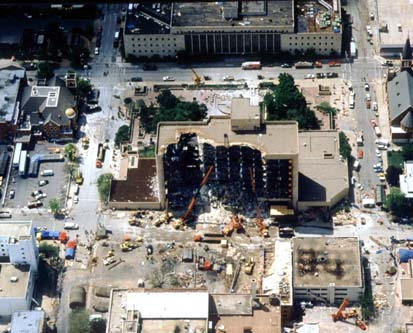
On a sunny April morning in 1995, the worst terrorist act on US Soil occurred with the bombing of the Murrah Federal Building in Oklahoma City, Oklahoma.  It would hold that uneasy crown until another sunny morning in September of 2001 in New York, Washington D.C. and a lonely field in Pennsylvania.    Since federal agencies were victims in OKC, the government agencies swept in and removed all the security tapes of this historic and deadly event.  These were crucial as evidence and as history.  These types of artifacts are safeguarded, preserved, and archived for legal studies and historic research.

Apparently not.   According to a story  about  a legal request for the tapes, it was made known that the tapes and other documents were deemed unimportant to even index and represented a burden for government employees to search.

This is unfortunate as it would lay to rest - finally and completely - if the videos were found, and could show clearly that McVeigh was alone.   At least three individuals testified in September of 1995 that they saw McVeigh with not just one person (the famed 'John Doe', but another man as well) ("Witnesses Say McVeigh Not Alone." Daily Oklahoman, Sept, 2, 1995, pg. 42).  

All of this - inevitably, clear as day, obviously - unites to make so strange the decision of the ATF to not test whether the truck bomb had the power to produce the devastation of the bombing as one of the most illogical decisions ever.  ("ATF Calls Off Plan to Test Truck Bomb" Daily Oklahoman, Sept, 11, 1995, pg. 11).  Let's see, we can show that  this bomb could do that much damage, but we won't need that evidence.   

Just like the strange decision to decide that the historic and valuable tapes and files of the investigation of the worst man-made disaster on US soil were not important enough to be cataloged or located.  After all, no body will ever want to access that stuff now will they?

The MSNBC program 'THE MCVEIGH TAPES' is another clear way  to not instigate a historical mystery.

This documentary purports to provide McVeighs own words and does allow some of his own words to be heard.  Instead it largely brings cherry picked snippets with talking heads filling in and explaining how McVeigh's growing anger was focused and his wrath was directed.

Yet, you never hear McVeigh actually saying saying any of those things the talking heads insist he said or meant or felt.  He is never shown ranting, never growing angry, or acting crazed (insert image image of an interview with Charles Manson for contrast).

So to create a lasting historical mystery do three simple things:

-Lose, destroy or minimize evidence
-Refuse to search for and preserve all evidence for future research and study
-Put words and inflections in the mouth of a historic figure.

Although, officially closed in 2006, with such slip-shod record keeping and unanswered questions, it will remain a riddle in search of an solution.


BEFORE THE MURRAH BUILDING BOMBING

When the federal building in Oklahoma City exploded in April 1995, it was a shock that rippled at sonic speed across the psyche of the country.  How? Why? were the unanswerable questions on everyone's lips.

Something, however, was stirring in the country in the years before this horrible disaster.  The 'Unabomber' was on the news radar as well.

  • In August 1991, teens apparently for a lark used a pipe bomb to blow up a portable toilet at a construction site in the elite Nichols Hills area of OKC.
  • In December of 1991 an OKC man was arrested in a pipe bomb case.
  • In February 1991, six pipe bombs were found on two chemical tanks in Virginia close to one of the major naval bases of the east coast (Daily Oklahoma, Feb.5, 1991, pg. 45).  
  • On October 1992, three bombs went off in two north central Oklahoma communities within minutes of each other, according to a story by Daily Oklahoman reporter Michael McNutt.  Pipe bombs exploded in two Enid government offices and one in an elementary school in  nearby Stillwater (about 25 miles south of Perry, Oklahoma where McVeigh would be found after the bombing), and home of Oklahoma State University.   All exploded with minimal damage.   Another discarded bomb - a thermos type container filled with gun powder - was found in a field  8 miles SW of Waukomis, Oklahoma (Daily Oklahoman, Oct. 28, 1992, pg. 108-09).
  • In January of 1993, a pipe bomb was found in a movie theater in Dallas, Texas.
  • In August 1993, Edmond teens were arrested for making pipe bombs.
  • In February 1994, Adair High School in Tulsa, OK was temporarily closed following a pipe bomb incident.
  • In March 1995, a pipe bomb was reported in Broken Arrow.
  • In June 1994, pipe bombs were found in the OKC Jail!

7/15/11

THERE IS ALWAYS A STORY WITH THE PHOTO

A little girl in Wellington, Kansas in the early 1960's and her first visit to the historic Antlers Hotel:

I was waiting eagerly to be old enough to go to Kindergarten when the photographer came to town and set up shop on the 4th floor of the old turn-of-the century hotel on a corner downtown. It was an elegant old Victorian hotel named, I was told, for the huge rack of antlers over the registration desk. I was so excited as we walked down the sidewalk past the shops and the magic of so much going on. Cars glided by, trucks rattled to a stop at the blinking lights, and people hurried past us on their way to their own adventures.

Climbing the front steps and entering the lobby was awe inspiring. Everywhere was the shimmer of old, polished wood. There was an exotic feel to the place with the old Persian rugs, the leather furniture, the wood railing leading upstairs. There was an aroma of pipe tobacco, perfume and beeswax used to give the wood that sturdy shine.  Strange people milled all about, mostly men reading newspapers, but a few women carrying shoppng bags from the department stores downtown.

Whispered comments had mother giving me sparse definitions of new terms like "salesmen", "bachelors", and "travelers".


We climbed the thickly carpeted stairs until we reached the desired floor. I had never seen such a long hallway before. It seemed to stretch forever. On each side were doors with shiny brass numbers. Hurrying down the hall, we did not want to miss the appointment, mother knocked on one of the strange and mysterious doors.


A man, gently stooped with a kind smile, ushered us into the room. It was a bedroom, I realized, even as I noted the man had set up a big screen to hide the bed and all around were cameras, lights, and strange bits and pieces of photographic equipment. The adults talked  about the photos and other small talk - just what I could not say.

I was soon being placed on a leather covered stool, told to look here, smile now, and pose this way and that. My mother looked through the camera, smiled, and nodded at the man's comments. Then the adults talked the business of payments and mailing the photos and other details of no concern to me. 

I was too interested in the little stool that spun around and around....

Settled on the stool, now still, the man made last minute lighting adjustments and then took several pictures of me in my blue gingham dress with my still toddler blonde hair falling to my shoulders and we left shortly after that. I skipped down the hall with a lollipop and my mother clutching a receipt for the promised image.

The hotel closed, the schools brought in photographers, and things changed all over. Sometimes, though, I do remember that soft spring day in my pretty dress walking down a sun washed hallway heading to an adventure, and had I known it, a fading bit of Americana
.

-- Marilyn A. Hudson

6/1/11

CRY, BABY, CRY

The urban legend, folklore, and sometimes out right 'fakelore' of the numerous Cry Baby Bridges across the country is only a little less mysterious than the tendency of devotees to insist 'their' bridge is the 'real' one.

Most folklorists located the earliest tales in Maryland, Ohio, Illinois, and New Jersey to the 1920's-30's.  A couple of places even suggest a WW 1 dating for their story.  The story apparently gained new energy in the 1950's and by the advent of the Internet in the 1990's every place was spouting their own bridge!

As an example of an urban legend - a short tale with supernatural overtones - which cannot be proved due to their hallmark total lack of facts - it is unsurpassed. 

The strong sociological components of the legend make it clear it is a morality tale derived from concerns in society of their changing moral climate, a perceived crass disregard for life, and the sure judgement for those who transgress against society's norms.


The most common elements are a woman (sometimes a couple) are crossing a bridge, it is raining/snowing/ or they are speeding/fighting or the woman (or the couple) are so consumed by depression/guilt/shame/madness that they have an accident/fling the baby off the bridge/ lose the baby in the night.  As a result, the cries of the baby/woman/both can be heard in that spot for years afterward.


The BRIDGE - what better symbol for the transition of the youthful person from the innocence of youth and the awareness of maturity?

The BABY - symbol of the product of careless disregard of the social norms and the product of acting outside approved boundaries? A symbol of the future being thrown away?

The RAIN/SNOW/FIGHT - The crisis point following the realization of an error in judgement may have consequences we are unprepared to face.

The CRIES - the symbol of guilt and the sure awareness that sins and failures cannot be hid. They will  haunt us, draw us back, and make us pay.

Many folklorists, myself included, believe the story emerged from the Pre-WW1 to Post WW1 era known as the 'roaring 20's'.  It was a time of great concern for many as old customs, manners, values, and norms were being eradicated as a new generation took over.  The automobile made it easy for young people to get in trouble via speeding, driving farther afield, promiscuity, drinking, and other 'wanton' behaviors.  Youth were often cautioned about 'burning their bridges' or making a decision they could not undue.  Having a baby was a classic example.  If A (adolescence) + B (behaviors) = C (consequences), well the result was the Crybaby Bridge!

Like its companion legend of  "Resurrection Mary", with its underlying theme that if the girl  had stayed home like a 'good girl' she would still be alive, the Crybaby Bridge tales also carry the underlying theme that conduct was important and had consequences.

So far, no newspaper, book, or oral history collections have unearthed any version of the tale of a Crybaby Bridge earlier than about 1917 (here).   "Resurrection Mary", by contrast, is considered sub-genre to the 'Vanishing Hitchhicker' motif and there is some evidence that the VH can be traced back to the post-Civil War.

The Crybaby Bridge motif is most probably an early 20th century invention to convey moral values, warn of sexual indiscretion, and safeguard human life.


5/30/11

EARLY LEADERS REVEALED IN EARLY PHOTO

In this photo from 1945 a young Oral Roberts is shown attending his denomination's general conference, held in Oklahoma City that year.  Roberts is shown in the lower right corner framed by the ladies in the hats.  At the opposite corner is the young entrepreneurial minister, R.O. Corvin, who would be in the next year the first president of Southwestern Christian University (then located at 5000 NW 10th).

EARLY OKLAHOMA CITY CHURCH CONFERENCE

In 1945, the Pentecostal Holiness Church meet in conference at the Oklahoma City First Church.  This church had begun in 1907 in the old 'Blue Front Saloon', 7 West Grand.  It later moved to 423 West California and in 1945 was located at 2046 E. 2nd Street.  In 1950, they relocated to 1701 N.W. 7th (9th and Blackwelder) under the leadership of pastor, the Rev. S.N. Greene.  The church, the First Pentecostal Holiness Church, was historic in being one of the first pentecostal churches in Oklahoma.   It is believed this image shows the church at 2046 E. 2nd in Oklahoma City.


5/29/11

Deadly Oklahoma Tornadoes

According to NOAA, there have been several tornado storms since 1947 which ranked F4 and F5.  The Woodward storm of April 1947 was part of a multi-state outbreak, was an F5 and it claimed 116.   One in November of 1930 struck Bethany along the area of NW 39th Street.   "The tornado moved north-northeast from 3 miles west of the Oklahoma City limits, hitting the eastern part of Bethany. About 110 homes and 700 other buildings, or about a fourth of the town, were damaged or destroyed. Near the end of the damage path 3.5 miles northeast of Wiley Post Airfield, the tornado hit the Camel Creek school. Buildings blew apart just as the students were falling to the floor and looking for shelter; five students and a teacher were killed."  It was an F4 and over 20 were killed. Overall about 100 tornadoes have hit OKC in the last 100 years.

5/3/11

REAL LIFE MYSTERIES REALLY ARE THE BEST

It has always been the silent voices, the untold stories, the hidden truths and the buried subtexts which have appealed  as I began delving into history. Those invisible, ghost-like people that "society" often tried to silence, make go away, or simply destroy.  The life of a poverty stricken yet strong 12 year African-American girl from Muskogee, Oklahoma name Sarah Rector, is just such a tale. Walking the dangerous balancing beam of crafting her future as sharks of racism, greed, and self-doubt trolled her early years, she has much to share with modern women, modern society, and much to add to the history of African Americans. 

Author and descendent Kelvin Rector is on a mission to share the surpring mosaic piece which helps to complete our knowledge of Oklahoma during the pre-statehood days, the impact of racism, the power of greed for oil and the wealth it represented, and the urge to manipulate society and some its members in order grasp that power away.

4/25/11

ALL THE SIGNS ARE THERE: Is Your House Haunted?

I was asked this the other day and as I searched I found there are numerous lists from as few as six signs to as many as sixteen and some who were obviously leaving the door wide open. Further research seems to suggest that these are considered the most common and likely signs of a 'haunting':  Unexplained cold spots, Shadows, sounds, or movements otherwise unexplainable,  Moving objects, opening doors - all unexplainable, Unexplainable moods, changes in atmosphere, or feelings of being watched, or Sightings of unexplained people, animals, or faces in or around a house which are unexplainable. 
You see, the key factor is  it must be 'unexplainable.'   Air in plumbing can groan like someone is being tortured on the rack, can thump floors and shimmy pipes over several floors giving a distinct feeling of some unseen presence. Air flow through a building can be diverted or blocked creating 'cold spots' or strange cold breezes. Old wood can contract and expand cracking open doors and drawers and knocking things off an otherwise even shelf.   Tiredness, flickers of electrical current, vision problems, and birds flitting past a window can create the illusion of something moving past, a shadow rapidly speeding across a room, and slinking in a corner.  Digital photography can capture orbs of light which are merely dust particles, refraction in old wavy glass can create a false play of light and shadow which the brain interprets as a "face" or nearby sounds carry on the wind leading to ideas of disembodied voices.

The amount of things we do not know about how old houses and interact with their geologic foundations, the  interactions of a location with any underground water sources, the possible correlations of electrical storms and 'sightings', and the power of the human imagination to create what it expects to see, all combine to insure we keep learning and trying to understand our wacky and wild world.


4/11/11

What Was Lost? What Can We Still Learn?

In the movement west, European-Americans found strange and mysterious earthen mounds - some of awesome size - and reflecting a great amount of communal cooperation and common purpose.  The often migratory, hunter-gatherer populations of the East, Southeast, and Middle regions seemed removed from what were clearly a more urban minded people.   Using a mindset that equated cultural development solely with specific types of society, they often dismissed any connections, could not accept that social history could be anything but linear, and  devalued anything not meeting preconceptions of an "important" or "civilized" society.

As a result, although many early and large earthen works or "mounds" were  recognized, protected, and preserved, many others were grazed, robbed, and otherwise destroyed.  Valuable information about the earliest community activities in North America were lost without study, record, or concern.  Some questions will never be answered about migration patterns, materials, methods, and relationships because valuable data was lost in the hurry to find mythical "treasure."   The lessons of the Spiro Mounds Archaeological Park in Spiro, Oklahoma are worth noting.  Hailed as an American "King Tut's Tomb" - not for its gold but for its rare information on early occupation.  Yet, it was nearly destroyed, robbed of its information, its contents desecrated with cruel abandon.

For most of the mound building cultures, these earthen works were part of sacred rituals of burial, death, and beliefs in the afterlife.  Archaeologists were seen as 'tomb robbers' and their actions synonymous with going to the local graveyard to dig  up a loved relative.  In most cases, you see, the occupants did not disappear but are connected to various groups who continued to develop and evolve as revealed through customs, linguistics, DNA, and cultural stories.  It was often seen as personal affront and sacrilege of sacred spaces and disturbances of final resting places. 

Spiro Mounds is the gem in Oklahoma but other sites stretch from the Canadian border to Middle America; from the Virginia hills to central plains.

What remains a mystery, however, is how these early groups functioned, what they believed, and how they might have related to other people groups.  These may never be fully answered due to the wanton destruction of some of these sites across the continent.  Their artistic style was as unique to other Native American art as Etruscan art was to Roman art.  They offer a rare glimpse into a more full understanding of human occupation and the connections and cultures of ancient humans.

In the assumptions about social development, definitions of civilizations, cultural superiority and prejudice rare pieces of history were lost - perhaps forever. As new theories of migrations,  multiple approaches to settlement, and new evidence continues to come to light pushing further and further our understanding of time lines and influences, what might yet still be there to be learned and what was lost?

4/10/11

AWFUL, MORBID, GRUESOME

No, not the National Press Club. These are terms used in the newspapers of early Oklahoma City to describe a serious of awful finds in the city dump. "Mountains of mangled flesh" or bodies most "dreadfully abused and mutilated." People pondered often in the midnight dreary what monster walked among them. Not even twenty years past the dreadful "Jack the Ripper" crimes of London Town - there was much for the imagination to contemplate. One story told of the finding of a small infant whose tiny body had been horribly "mutilated" by skilled hands and then the tiny body tossed on the "ash heap." One headline questioned what awful ghouls were prowling the gas lit streets of the new capital? The slasher in this morbid tale was none other than the local medical school, Epworth College. Or, to be more precise, the janitor of the facility. It seems that he had simply taken the discard body parts, bloody cloth, tumor removals and even corpses used in practice dissections, to the local city dump.   

3/25/11

WHO WAS VIVIA THOMAS?

One of the longest and most intriguing tales of the Sooner state involves a woman who masqueraded as a man.  Various versions have been shared but all have the same basic tale:

"One of the most interesting stories associated with Fort Gibson National Cemetery is the tale of Vivia Thomas. Legend has it this high-spirited daughter of a wealthy Boston family met and fell in love with a handsome young lieutenant at a ball following the Civil War. After several months of courtship, they announced their engagement, but shortly before the wedding he left, leaving only a note that he desired to go West in search of adventure. Broken-hearted and bitter over the abandonment, Thomas went in search of her lover. After learning that he was stationed at Fort Gibson, she set off on a journey of revenge. She cut her hair, dressed in men’s clothing and joined the Army. The disguise worked, as the former fiancé did not recognize her. One night as he was returning from a visit with his Native American girlfriend, she ambushed and killed him. Despite an intense investigation, the murder went undiscovered. However, Thomas grew remorseful and began to visit his grave late at night. Eventually she contracted pneumonia from the continued exposure to the cold and collapsed near his grave, dying a few days later. Rather than condemning her actions, her army colleagues were so impressed with her courage in coming alone to the frontier and carrying out a successful disguise that they awarded her a place of honor for burial in the officer’s circle." (http://www.cem.va.gov/cems/nchp/ftgibson.asp)  Her grave is  in Section OC Grave 2119.


Of course, in such a ceremony all are notable by their service, their valor, or their leadership.  If you pause to find Vivia, stay long enough to tip the head to :


"Medal of Honor Recipients
Private First Class John N. Reese Jr., (World War II), U.S. Army, Company B, 148th Infantry, 37th Infantry Division. Paco Railroad Station, Manila, Philippine Islands, Feb. 9, 1945 (Section 2, Grave 1259-E).
First Lieutenant Jack C. Montgomery, (World War II), U.S. Army, 45th Division. Padiglione, Italy, Feb. 22, 1944 (Section 20, Grave 963).

Others
Talahina Rogers - Cherokee wife of General Sam Houston - Section OC, Grave 2467
Captain John P. Decatur - Section OC Grave 2101
Major Joel Elliot - Section OC Grave 2233
Nelson P. Fonseca - Section 14 Grave 675" (ibid.)

But - who was she?  She is listed in the Post Cemetery Records for Fort Gibson, Indian Territory showing a death date of January 7, 1870. (Ancestry.com. U.S. Military Burial Registers, 1768-1921[database on-line]. Provo, UT, USA: Ancestry.com Operations Inc, 2007.  Original data: Burial Registers for Military Posts, Camps, and Stations, 1768-1921; (National Archives Microfilm Publication M2014, 1 roll); Records of the Office of the Quartermaster General, Record Group 92; National Archives, Washington, D.C.)  No other identifying information is indicated in the record.   


There are other deaths without such details and that appeared to be the standard practice for those considered non-military.  So that leaves her place of burial to offer clues as to  
the truth of the basic story and the strength of the legend to stand the test of time.

MAY THEY REST IN PEACE: Another Urban Legend Bites the Dust - UPDATE

The cemetery has now been opened, the final graves appear to all be gone, and only the memories of those who lived, died, and grieved there remain.  The city park has expanded, walking trails go past the old cloistered corner with its sentinals of scraggly pines.  If you walk or run in the area, slow down and remember those who once rested there.
For many years, an urban legend floated among community members that the cemetery on the northwest corner of the Eldon Lion's Park in Bethany had to be haunted - it was overgrown, shady, and secretive. It looked the part.   It was the cemetery associated with the St. Joseph's Children' Home.  Bizarre tales emerged fed as much by anti-catholic sentiment as any real fact; but some times in perpetuating urban legends that is enough.  Recent televised explorations of sanitariums in Kentucky and Ohio have added a new word to the lexicon of urban legends.   The term 'death tunnel' is spoken  in hushed sounds as if nefarious acts were to be associated with such a feature of an institution.  Thee truth is less attractive and far more practical.  In some settings such a hidden avenue for the removal of the dead was a necessity.  It provided them some last privacy and, in settings such as hospitals and orphan care facilities, some protection to those who resided in the facility as well.  It was also very practical when the location was one where long winters or protracted rainy seasons might preclude being able to bury a body in a timely manner.  There is some indications that such a feature was at the Bethany location, according to sources who wish to remain anonymous.  However, long before the facility closed, it was sealed shut and had not been used in decades.  The people who had been buried there - the orphans who had died of fevers, the nuns of old age, and the older people who had come there to end their days - were respectfully interred.  When the facility closed, the nuns and priests buried there were transferred to another burial site.  If any graves remain in the tiny shady corner, let them rest in peace.   As you pass, whisper a tiny prayer and grant them respect and dignity.

St. Joseph's Children Home, Bethany, Oklahoma

Top image is late 1960's shortly before it closed at the Bethany location.

The sport fields between Route 66 and the front of the institution, as they appeared in the 1940's.

St. Joseph's Children Home, Bethany, Oklahoma c1927

n is top

St. Joseph's Children Home, Bethany, Oklahoma c1912

THE ORPHANAGE ON THE HILL


THE SAINT JOSEPH CHILDREN’S HOME
A Brief History based on an entry in the Bethany Centennial History Book (2009)
By
Marilyn A. Hudson

Just three years after Oklahoma statehood, 27 ½ acres of land were purchased to create the “St. Joseph Orphanage Asylum and Industrial School.”  The land was excellently situated near the half-way point of the new “El Reno Interurban” rail line connecting Oklahoma City and Yukon. With 60 acres by 1913, early promoters noted the gardens, truck produce, farming, and livestock of the orphanage would advertise the rich farming potential of the area.[1]  The facility grew to include various tracts of land and included   the “north farm” where the present day St. Francis Center for Christian Renewal and Resurrection Cemetery are located.
Overseeing this scale of a charitable endeavor in the Roman Catholic Church of Oklahoma required strong leaders.  The Very Rev. Bernard Mutsaers, James Maney, and His Excellency the Right Rev. Theophile Meerschaert, Oklahoma’s first Bishop, proved to be those leaders. The Rev. John M. Kekeisen, late of Newkirk, assumed the position of first director of the orphanage. Other Directors were Fathers P.P. Schaeffer, James Garvey, and A.A. Isenbart.[2]
On August 1, 1912, Sister Mary Scholastica, Superior, and Sisters Mary Anthony. Mary Raphael, Mary Ambrose, all Sisters of Mercy, arrived to receive the children. On October 6, 1912, Bishop Meerschar performed a solemn service of blessing celebrating the new facility.
In 1921, Father P.P. Schaeffer, foresaw a need for infant and elderly care.  The Article of Incorporation at that time to “St. Joseph’s Orphanage and Home for the Aged.”  Father Garvey, starting in 1928, used a popular annual parish picnic to raise funds to reduce the orphanage indebtedness. The result was that by 1934 the mortgage on the orphanage was fulfilled.
Over the years, the large brick building set on a gentle knoll, saw a gymnasium added, a chapel, and classrooms.  It was central to many of the charities of its day for Catholics in Oklahoma and the people they helped.  The history of the Oklahoma Catholic Charities also begins at St. Joseph, as they were headquartered at the orphanage until 1926.
Over the next sixty years, the orphanage would see many changes in its structure, outreach, and workers.  More than seven orders of women religious served there (Sisters of Mercy, Sisters of the Blessed Carmelites, Benedictines, Missionary Sisters of the Most Blessed Trinity, Sisters of St. Joseph, and the Divine Providence Sisters)[3].  
In 1965, the Children’s Home relocated to an area off Eastern Avenue in NE Oklahoma City with a modern set of dormitories, cafeteria, and chapel.[4]  Changes in society were making orphanages less common[5]. In 1973, however, the original facility, empty for three years, sold to become the general offices of the International Pentecostal Holiness Church.[6]
From its opening in 1912 to 1955, St. Joseph provided care for some 5,000 children.[7]   Many were like the child a Sister Providentia recalled.   A tiny girl, neglected by her family, asked the Sister if it was true they “really received three meals a day…”[8]  Happily, the St. Joseph Orphanage could and did provide three meals and much more.


[1] “Orphanage plans more buildings” Daily Oklahoman. 4/14/1912; special thanks to James Weinmann , Heritage Room Director, Catholic Pastoral Center, Archdiocese of Oklahoma City.
[2] “Diocesan Charities Office Has Cared for Thousands.” Southwester Courier: Golden Jubilee, n.d., pg. 96-97.
[3] “St. Joseph’s Children’s Home.” The Sooner Catholic. Sunday, Sept. 5, 1976.
[4] “Empty Orphanage a Tranquil Store of Memory.” Daily Oklahoman. (5/27/1973, pg. 22).
[5]  “Necessity for Orphanages has virtually disappeared.”  Daily Oklahoman (12/26/1974), pg. 87).
[6] “Church to move headquarters to City.”  Daily Oklahoman (8/7/1973, pg. 11).
[7] Quoted in “St. Joseph’s Children’s Home”. Sooner  Catholic, Sunday, Sept. 5,1976.; “Empty Orphanage a Tranquil Store of Memory.” Daily Oklahoman.  (5/27/1973, pg. 22).
[8] St. Joseph’s Children’s Home.” The Sooner Catholic. Sunday, Sept. 5, 1976.

3/21/11

DARK SPRING - Unsolved OKC Murders

Spring times are supposed to be about life and renewal and second chances.  Once upon time in central Oklahoma City the spring was dark and filled with visions to cause nightmares.
The first body parts showed up in April 1, 1976, in an abandoned house at 325 NE 8th in Oklahoma City, utility workers exploring an abandoned house found the head and body parts of a 18 year old Cathy Lyn Shackelford. At the time, however, she was unidentified and was labeled a 'Jane Dow'.   

Fast forward to April 19, 1979 when several grisly discoveries are made between mid-April and the first of May. All around the 300 block NE 10th and 200 block NE 7th in Oklahoma City.  The  second known victim was named Arley Bell Killian.

A strange gap of seven  years followed before another find was made.  On March 6, 1986, the body of   23 year old  Tina Sanders was located at 507 N. Lindsay.  A fourth has been suggested but unverified.

There are interesting similarities which might provide links to similar crimes and bring closure to this cold case. All the women were Native American, they either lived on the streets and/or worked as prostitutes, and were all probably killed within the same one mile radius where their bodies were found. The killings were in the spring, they were not rushed, and due to the ease with which the body parts were created and discarded, the killer had to have been familiar with his surroundings (the Stiles Circle - Lincoln Terrace neighborhood; now generally covered by the Centennial Expressway and the OU Health Science buildings and related structures).  Each body had an incision in the lower lip, massive body mutilation and dismemberment, and certain parts of the bodies were never found.

The chronology of the murders -1976, 1979 and 1986 - indicate there may have been a pattern at work.  Another killing (5) might have occurred in 1982-1983.  Just as possible, however,  the killer could have been in jail, in the military, or out of state on some job during the seven year break.  It is likely other killings, as of yet to be found,  may be fit that pattern.(Oklahoma Cold Cases) It would be atypical for such a killer to have such a long 'cooling off' period but not impossible.

Some suggest that another body was found April 22, 1995 and pulled from missing head, hands and feet, from a shallow grave 50 miles west of the city.   Authorities were said to note 'similarities' in the manner of the dismemberment. (Encyclopedia of Unsolved Crimes, 2009,p. 291) The time period is shortly after the Murrah Federal Building bombing in Oklahoma City and that story was the major news for several days and no report was found to confirm that suggestion.

In 1993, the combined efforts of Andra Medina, Sgt. Norma Adams, Norman forensic sculpture Betty Pat Gatliff, and well known Oklahoma based anthropologist , Dr. Clyde Snow brought closure to the first Jane Doe.  DNA identified her as Shackleford ("DNA Tests Identify '76 Slaying Victim". Steve Lackmeyer, Oklahoman, Nov. 30, 1993, pg.1).

There were also some 'interesting' bodies in eastern Oklahoma, not for from the I-40 corridor in Shamrock 1975, Wellston 1985 and Broken Arrow 1989. Also possibly other locations in 1985 and the early 90's.    Body parts or dismembered bodies of young women who apparently went missing unnoticed and unidentified.  The 1960's through the 1990's were especially violent with serial killers springing out of their dank worlds to grab headlines through gory acts: Kemper, Bundy, Rader and so many others.


What happened to the killer? Where did he go?  One notorious killer confessed to some of these deaths but the confessions are considered by most as suspect, the last minute greedy attempt by a sociopath to get attention.  If that is true, then chilling questions remain. When the region was razed by bulldozers and new building rose over the bloody grounds, what secrets were lost?  Are there other victims  out there - somewhere? Victims of this monster who stalked the streets to prey- at leisure -  on women struggling just to survive?

I Write Like...

I write like
H. P. Lovecraft

I Write Like. Analyze your writing!

Expanded and Revised Edition

Expanded and Revised Edition
Coming Soon!