6/23/13

The Classen Corridor: Just beyond Route 66, Kamps Court

In Oklahoma City, along the broad Classen Blvd. north and south of the juncture of NW 23rd and Classen are many historical gems. They hark back to days when this area was 'out in the country' and on the edge of the growing community.  They remind of heady expansion and opportunity and growth: all things well worth remembering as a new century dawns and continued renewal and rebirth occurs in its rediscovered neighborhoods and business districts.  They are examples of small businesses that succeeded and contributed to the development of the capitol city of Oklahoma.

Kamp's Grocery and Kamp's Courts - In 1910 two German immigrants discovered what was then the outskirts of Oklahoma City and settled down to establish business. Kamp Brothers Grocery at NW 25th and Classen Boulevard was well known for top quality groceries, deli, breads, and service.

In 1928, the  business name was used  in ads appearin local newspapers.  The image of the cute apartments solicited a short ride to see the area.  The urged people to come discover the cozy but green living space where every one had their own garden.   "Kamp Courtyard" advertized they were  bringing a new style of living along NW 25.    They actually purchased the land from Wesley Methodist who were using a building there for "overflow" classes and events.

More recently, the business transformed.  The original Kamp's moved to Bill Kamp's Meat Market at 7310 N. Western over 12 years ago and state "we are still going strong after 103 years."   The Cafe is not related to Bill Kamp who is the third generation of butchers, continuing the same business at a different location. The Midtown ("Kamps1910 Cafe."; 10 N.E. 10th ) is not related.  A new business featuring Peruvian food is now there at the corner of Classen and NW 25th.

Yet, the history lingers on along the corridor, hinting at a past worth preserving and remembering.


Mystery and Money

It is the eternal connection and cause of crime - money. The love of it, the shortage of it, and desire for more of it has been the spark causing trouble and discord since it was invented.  Attempts at social programs designed to equailize access to it and the things it provides are often as riddled with corruption as the piece of Swiss cheese in the fridge for lunch is filled with holes. There is an often seen problem of the inability to use the money of others with sanity and efficiency found in local, state, and federal government offices and agencies.  The government, on any level, does not have any money of its own (it does not produce) but rather is dependent on the money (taxes, fees) placed on the citizens (producers).   As a result, some of the most absurd waste occurs in and through government agencies.

People were aghast in the 1970's and 1980's when government excess, overspending, and bad business practices were uncovered.  The government, which has no money of its own, was spending over $600 dollars for toilet seats!  The history and track record of such poor business management and purchasing practices can be traced throughout school districts, government offices, and federal programs over decades.

"Community Action Program" (CAP) was a part of the Johnson era 'war on poverty' program.  In the 1970's and early 1980's one program rented space in an empty wing of a local building.  They transferred to a 'new building' in an old school building and when they left - they left.  The rental space contained metal desks, chairs, filing cabinets, various office furnishings, equipment and supplies.  The file cabinets were still full of records, resources, names and addresses.  There were files packed with 'plays' about the need for revolution, the need for programs to help addicts by supplying drugs instead of criminalizing them and celebrations of the ability to have free love and safe abortions.

 They were getting 'new' furnishings in the new location.  Boxes of pencils, pens, paper, paperclips, staples, staplers, and typing/copy paper was simply left behind to be replaced by brand new supplies.  Chairs, desks, tables, lamps, electronic pencil sharpeners, file cabinets, trash cans, clocks, and other items were simply left to be replaced by new items in the new location.  Who paid for this collossel waste and abuse of publicaly supplied funding?  

Take a look in the mirror.  The mystery here is one of continued lack of oversight (apparently the government oversight agence catching the military overspending in the 1980's never looked into other domestic agencies).   As one of those hired by the building owners, I saw this all first hand, as we cleaned and got ride of the extra 'stuff' the renters left behind.  So, stay cautious when you hear some government agencies talk about how efficiently they use their budgets, how cost conscience they are.  Waste is easy when it is someone else's dollar and conservation near impossible.  The mystery is why we so often continue to allow such abuses to go on without more accountibility.

6/12/13

HISTORIC ROUTE 66 IN OKLAHOMA CITY: Wesley UMC


The historic roadway known as "Route 66" takes a small turn in Oklahoma City (map) and as a result offers some interesting sites to see.  The Gold Dome, the Milk Bottle Building, and Wesley United Methodist Church.


Wesley UMC was established in November of 1910 by Bishop Quayle.  The current classic English Gothic style building was formally dedicated as the Wesley Methodist Episcopal Church in 1928.  Rising high above the surrounding residential area, it would have been plainly visible to those motoring 'the road.'


Route 66 traveled along 23rd Street (great detail map) between the area of the Capitol complex and just east of Oklahoma City University - taking it past the location of Wesley UMC.  Some historic signs signify some of this area but it is begging for a higher profile treatment to preserve the unique travel route through the area. 

Gothic Interior
of Wesley UMC

Within a short distance of the 'road' was the historic cemetery of early Oklahoma City where both the noteworthy and the notorius found their final rest. Fairlawn Cemetery was established in 1892. 

A novel building featuring a milk bottle reminds of the industry that once thrived and the creative way businesses promoted attention. A few block further, just north of 23rd street on Classen, is the old The Townley Milk Company building owned noe by Braum Dairy.

The historic Gold Dome is a newer structure in a geodesic dome. It was built in 1958, as the glory road was dwindling, and is now on the Register of Historic Places.  It is struggling to be preserved and recognized as a linchpin of the emergent "Asian District."  

Surrounded by historic residental areas and hope to be historic areas, and other areas,  the Asian District, the art centered Paseo district, and historic Route 66 the area is a potential gold mine for development building on these unique and heritage rich elements. Hopefully, as Steven Lackmeyer also hopes,  more city and local leaders will recognize the need and benefit from highlighting this area as a broader "Route 66-OKC" tourist feature. 

Wesley UMC
The Wesley UMC retains many significant aspects: artistic, original stained glass dating from its building in the late 1920's.  Highly detailed Gothic architecture reflects the teaching moments of the Middle Ages churches. In that distant era church goers often did not understand the Latin of the old church services, they were uneducated, and illiterate.  The old catherdrals were often called 'sermons in stone' because of their use of artistic means to teach Bible stories and theology.  The Sanctuary of Wesley is laid out in the classic shape of a cross, the doctrine of the trinity is expressed through the use of classic symbols and the groupings of doors and lights in sets of three.

Deeply imbedded into the early history of Oklahoma City, this stretch of Route 66 offers glimpses of both a bustling growing modern city but also rare glimpses of the rich heritage hiding around nearly every corner. 

Put the sunglasses on and take a trip down old Route 66....Oklahoma City Uptown area.

5/26/13

Look to the Skies: Kansas UFO Story

As Rod Serling said, there is a signpost up ahead...or in this case, along Highway 81 in southern Kansas in a small town begun in the cattle wealth of the late 1800's.  

Here, for your enjoyment and thrills are several tales from this community.  Others exist but they remain tucked away in corners, memories, and local legend.

Place: Wellington, Sumner, Kansas (west of town near lake)
Time: 1960-1962
Description:
"
...the road by the lake....when it seemed everyone had disappeared and there was a bowl over the area locking in sound, making a gray sky...there is a latter memory of other people, cars and everyone standing as if frozen and I walk past them...I was scared...but it was - distant - as  if I was drugged or cut off from all emotion...


When I first began to search for evidence of strange events in the area of my childhood home, there was lot of nothing available online. Records were hidden away, lost in newspapers not digitized or easily available, and otherwise inaccessible.

In the past decades, this has begun to change.  I revisited the subject and found there were ‘flaps’ and they did coincide with several of the incidents in my personal memory. In addition, I found at least one other person who shared a similar event in a nearby community."


In 1960 or 61 (date is approximate at present based on directory information as to when the family resided at the home near east 7th and Douglas). "I was coming home and found myself being followed by small gray "things" - I cannot explain more. They were very nebulous and indistinct. I could see through them and I know I was afraid. I had been playing in an old rail yard behind our block (lots of sand hills). I was headed home ...the memory of the heavy sense of anxiety, the turning to look over my shoulder at the 'men' and the sense they were following are accompanied by a sense of moving in very slow motion...of a strange caste to the air and the sky...a strange amber bubble that encased the episode... Soon after this, I discovered a small healed scar on the back of my thigh - yet I had not been hurt there (it was about 1-1.2 inches long). It showed a strange "weaving" pattern of skin growth between the two smooth edges with tiny pinpoints around the edges. It remained faintly white for many years but is faded now. This was nearly 50 years ago and the memory has remained clear and insistent - like a tooth ache that has refused to go away. I am sharing this now - in the hope that it may help someone else who may have also encountered "something" strange during that time in this location."

About this same time, around the area of Wellington Lake, came a report of a strange experience along a sandy road among a thick cover of foliage.  "I was a small girl and we  had gone out to the Lake for a drive. I remember the sun as we drove through the trees, seeing the sparkle of the lake...my next memory is walking, alone, down that same stretch of road with everything absolutely silent. I remember how tall the trees seemed walking alone down that road. It felt as if a clear bowl had been unended over the area and no sounds or winds were heard. It also gave a gray caste to everything, as  if it had suddenly clouded over.  I remember walking down the middle of the road in that thick sand wondering where did everybody go? .. I remember seeing our car, but at least one other car also, stopped at the side of the road. I remember seeing everybody just staring, blank looking, and then we get back in the car and drive away...everybody is silent until we move away from the gray area....and then it was as if nothing happened."

In about 1963 (thought to be no later than 1964) a resident in a house on North Jefferson street in Wellington, Kansas, reported "my brothers and mother and myself observed a red light bathe the backyard, there was no sound, no wind, nothing but the light." Later interviews with this witness indicated the red light covered the entire sky above the area just out the back door. She remembers seeing the mother and a brother go out and look up wondering what the thing was. The witnessed reported "Its appearance was similar to the "safelight" used in darkroom photography. Then it was gone, like a light being switched off. Details of the source were not visible; you could only see the red-orange round source of the light itself. I remember looking out the screen door, walking outside, looking up and then the next thing I remember is looking back into the house with the light gone. "

1958 in Topeka, Ks the wife of a local doctor sees a small amber glowing craft on the walk in her yard, it stirs her dogs and as she watched it shot out of the yard and a nearby neighbor hurried over after seeing the strange light shooting upward. 

In June of 1960 and in August, witnesses reported several incidents.  The June event was witnessed by a child who reported it years later. She lived on Maple street in Wichita.  She indicated a story of a sighting had appeared in a paper at that time but could not find the article. She also reported other strange experiences: “THIS HAPPEN WHEN I WAS SIX TO EIGHT YEARS OLD. I HAVE BEEN TRYING TO FIND THE NEWS PAPER ARTICLE ABOUT THE OBJECT THAT WAS IN THE WICHITA EAGLE AND BEACON MY MOTHER SHOWED ME THE NEXT DAY . IT WAS A SMALL SECTION IN THE PAPER , IT STARTED OUT WITH BUSINESS MAN AND FARMER SEE UFO . I WAS OUT IN THE BACK YARD AT 2015 W. MAPLE IN WICHITA KANSAS IN THE SUMMER TIME SOMEWHERE BETWEEN 1960AND 1963 . IT WAS INTHE LATE MORNING TIME BECAUSE MOTHER WAS DOING THE MORNING DISHES . I WAS PLAYING UNDER A TREE ON THE GROUND I WAS BUILDING A RANCH WITH TOY COWBOYS, I HAD A PIN WHELL FOR A WIND MILL. EVERY THING WAS FINE UNTIL I HEARD A LOUD HUMMING SOUND, I LOOKED AROUND TO SEE WHERE IT WAS COMING FROM ,FINALLY I LOOKED UP AND I SAW A BRIGHT MULTI-COLORED OBJECT RIGHT ABOVE THE TREE WHERE I WAS PLAYING , IT JUST HOVERED RIGHT ABOVE ME I SCREAMED FOR MY MOTHER…AFTER I HAD SEEN THE UFO WHEN I WAS STILL A CHILD I WOULD HAVE THIS DREAM . I WAS STANDING AROUND THE TREE WITH MY FAMILY AROUND ME AN SOMETHING WOULD SNAP , LIKE WHEN YOU SNAP YOUR FINGERS , HEN I WOULD START FLOATING IN THE AIR TOWARD THE TREE AND NO ONE COULD HELP ME . THEN I WOULD WAKE UP IN A COLD SWEAT …”  (https://www.sightingsreport.com/sightings/69056). 

According to NICAP reports on  Aug. 23, 1960; Wichita, Kansas. 3::24 a.m.  the following was reported by a witness. Boeing aeronautical engineer C.A. Komiske reported seeing one round object with yellow lights coming from what looked like three triangular windows at bottom. Object was dull orange and it flew in an arc for 2 minutes. (http://www.nicap.org/1960.htm)

I reported this (An early 1960's encounter with possible alien occupants near Wellington, Ks.  I was coming home and found myself being followed by small gray "things" - I cannot explain more. They were nebulous and indistinct. I know I was afraid. I had been playing in an old rail yard behind our block (lots of sand hills). I was headed home ...

Soon after this, I discovered a small healed scar on the back of my thigh - yet I had not been hurt there (it was about 1-1.2 inches long). It showed some "weaving" type of skin growth between the two smooth edges and tiny pinpoints around the edges. It remained faintly white for many years.

This was nearly 50 years ago and the memory has remained clear and insistent - like a tooth ache that has refused to go away. I am sharing this now - in the hope that it may help someone else who may have also encountered "something" strange during that time in this location (between 1958-1968). I had two; possibly three other things occur that I have also never spoken about (by the lake and in town - reported earlier). http://nuforc.org/webreports/042/S42484.html

Oct.14, 1960 , Wichita, MUFON, (MUFON Case: 9026) While attending Wichita High School Southeast,(1960) I, Donald Molzen, and Mike Greshiam belonged to NASA (as a volunteers). We tracked satellite launches from Cape Canaveral. On an evening in the winter of 1960 a lady named, Barbra Battie,(part of our team)sighted an object, which was also verified in Australia that same night. This object was seen for several nights [...]https://www.sightingsreport.com/sightings/74513

4 August 1961 - Cunningham, Kansas, USA -   Nocturnal lights were reported and the same day in Wichita,  Nocturnal lights were observed by a female witness (Buck).
http://thecid.com/ufo/chrono/chrono/1961.htm

In September 1961 in New England the famous Betty and Barney Hill case would unfold.
Strangely, in November (11-10-64)  1964 it has also been reported  that there had been a UFO crash and 9 bodies recovered and were allegedly stored at Ft.  Riley, Kansas.   Alternately, the story is the crash occurred there. Too few details to describe the situation.  (http://www.burlingtonnews.net/ufocrashes.html)

Red glow from unseen object

"On a summer night in 1964 or 1965, “ I reported later to NUFORC. “my brothers and mother and myself observed a red light bathe the backyard, there was no sound, no wind, nothing but the light. Its appearance was similar to the "safelight" used in darkroom photography. Then it was gone, like a light being switched off. Details of the source were not visible; you could only see the red-orange round source of the light itself.  I remember looking out the screen door, walking outside, looking up and then the next thing I remember is looking back into the house with the light gone."  (NUFORC Note: Time and date are approximate. Witness elects to remain totally anonymous. Please see another similar report for August 15, 1937, from Fontana, CA. PD)) http://nuforc.org/webreports/038/S38539.html

4/22/13

Tattoos

Think tats are a new invention?  Over the centuries many people groups have chosen to adorn their body for decorative, religious, or social purposes. 

Ancient peoples often adorned their bodies with ritualistic designs to identify themselves, perform some sacred function, or as artistic adornment. 

Native American Tribes

"When he first saw the Wichita of the plains in the early 1860’s, the older women were tattooed with pink and blue zigzag lines and circles as was their ancient custom." The author also saw their language sounded nothing like that of dialects encounter  in the east but did seem similar to a language spoken by a people in Oregon.---History of Wichita and Sedgwick County, Kansas: Past and Present (pg. 598) by Orsemus Hills Bentley.  Prisoners/slaves were tattooed, such Olive Oatman, they served to identify members of specific tribal groups, and served as rites of passage.


People of the Pacific
Maori both painted and incised designs to achive a multi-dimensional result on the face and legs. The men of Samoa would tattoo their legs, hips and groin area to give the impression of cloths yet were naked. 

Other
Ancient Chrisitianity advocated for the use of religious tattoos but the rejection of such symbols that reflected pagan or heathen superstititions.

Jewish people usually held to Old Testament restrictions of cutting or marking the flesh, in a manner similar to that required by worshippers of Baal.  By modern times most continued this prohibition, a fact that adds more insult to the Holocaust victims being tattooed in WW2. 

Oklahoma Orphanage Plans Reunion


Here is an invitation for all Former Residents and Staff of St. Joseph’s Orphanage in Bethany, Oklahoma
"Did you hear about the reunion...?"
and St. Joseph’s Children’s Home in Oklahoma City. 

REUNION - SAVE THE DATE - SPEAD THE WORD
A reunion of former residents and staff members of St. Joseph’s Orphanage in Bethany, Oklahoma, and St. Joseph’s Children’s Home in Oklahoma City is being planned for Saturday, June 1, 2013.  Arrangements are pending. 

If you ever lived or worked at the orphanage or children’s home and would like to receive information about this reunion, please mail, e-mail or phone your contact information to Jane Moon, Catholic Charities, 1501 N. Classen Blvd., Oklahoma City, OK 73106, jmoon@catholiccharitiesok.org, 405-526-2308.

The home was opened in 1912 in Bethany, Oklahoma and later moved to Oklahoma City.

4/16/13

LITTLE GREEN MEN

When did the idea of little men from space first emerge into our consciousness?  Why did it arrive, if not from actual visiting alien craft, and what does it all mean?  Deep probing questions for sure.  

I was amazed to learn that stories of little men can be traced back to reports as early as the 1930's, predating the 1947 Roswell, NM event said to have sparked the idea.

In 1937 in Fontana, California it is reported a group of people on a dark rural road were illumunitated by an "unknown shaft of orange light coming from the sky while walking back from the movies".  Greatly frightened the group ran into a nearby orange grove for cover. Later one of the main witness remembered waking up at night finding his bedroom filled with a subdued light and four or five little figures with big heads and eyes looking at him."   "The figures appeared to be light blue or green gray in color. The figures then would move around and touched him. One night he recalled seeing the little men and a white light would appear at the door accompanied by a tall man (he could not see his features) that appeared to be in charge of the little humanoids. He never felt any fear during the encounters." Source: http://www.ufoinfo.com/humanoid/humanoid1935.shtml     Source: NUFORC.


4/10/13

RATIONING IN TIME OF WAR- WW2 Revisted

From 1941-1945 various commodities were rationed to ensure adequate supplies for the war effort, to stabilize the homefront economy, and to provide a means where every citizen could participate in the national effort. 

Gasoline, sugar, meat, grain, cloth - the list was long for items rationed.
careful planning was involved and collaborative effort in families to plan for meals and life using these stamps.

There were four books used and each had to be applied for (it was the Government, remember?).   

The following show some ration books issued to people living in Oklahoma (Tahlequah) but the process was the same everywhere. 


A look at all the books and the steps invovled at "Rationing During WW2" http://www.waverlyinfo.com/page/3282/Ww-Ii-Memorabilia

WAR RATION BOOK FOUR


This book and the certificate were issues to a 63 year old Minnie Catherine Mulholland, 306 W. Choctaw, Tahlequah, Cherokee Co., Oklahoma. The certificate was issued May5, 1942 via local board #43.

WAR RATIONS

A page of stamps used to dispense food to registered people during World War 2.  The paper looked to be recycled grade.

War Rations - Sugar Ration Book Page


This sugar ration book was used by Donald M. Wyatt, 306 West Choctaw in Tahlequah, Oklahoma during World War Two.

4/8/13

She Was A Most Lively Preacher

Representive image - Public Domain
One of the fundamental elements in any family's evolution is the influence of religion in crafting their traditions, values, and daily life. Like vines, the religious and secular histories are often intertwined. Any attempt to understand the one divorced from the other is often a sure guarantee valuable insights will be lost. Understanding a family's religious history is to understand many of their motivations and subsequent actions with far greater clarity. All of this combines to present a multi-dimensional history of American life.  When a tantalizing suggestion of an early woman preacher in the family - the search took on new meaning.

The spread of Methodism in America parallels the trek of the early pioneers such as Daniel Boone (who cleared the trail into then largely unknown Kentucky in the late 1700's). The early Methodist preachers were not far behind such pioneers. Even before the formal organization of the "American Methodist Church" or the "Methodist Episcopal Church" (1784), there existed an early circuit (a regular route traveled by one minister in order to preach, baptize, and marry) known as the "Holstein Circuit" (Norwood). It covered the area of NE Tennessee, and SW Virginia through which John Terry, son of William, and his wife Esther Brown Terry migrated circa 1790. Other circuits would form, interestingly enough, in Botetourt Co.,Va, in Kentucky, and southern Indiana. All locations into which John Terry and kin were known to have moved.


The "father" of American Methodism, Frances Asbury (1745-1816) traveled some of those same areas of Virginia, North Carolina, South Carolina, and Tennessee on his own circuit journeys of the late 1700's and early 1800's. His journal records that in 1786 he stopped at "Terry's" on the border of Fairfield and Chester Co. Cited, re notes, as "Tar Yard" on some old maps. In 1807 he stopped at "Terry's" in the upper part of Greenville Co., near Marietta. The notes indicate this should not be confused with the Terry at Fork Shoals 20 miles below Greenville in NC. An 1833 letter reporting on ministerial activities noted "...my first efforts were in Botetourt, Holston, and New River Circuits 40 years ago [1793]...I kept up with [information?] Viz. Nathaniel Tery 4 miles distant in the bent of James River. (Clark, Journal and Letters of Francis Asbury, vol 1.;pg. 446,507,374-75,574).


Evidence from several private records reveal that one family, the Terry family of Barry Co., Missouri, were a group that took religion seriously. Some joined the Disciples of Christ, Baptist, and other groups, yet there are intriguing clues that seem to suggest some of these early Terry's had a connection to early American Methodism. Not surprising for a group that at one time could claim a church in every county, yet the details are fascinating and illuminate migration and family stories.   It also fleshes out some of the church history that is spotty at best in that heavily wooded and one time highly isolated region of the Ozarks,

Barbara Terry of Cassville, Barry Co., Missouri, writing to her son John and his wife Lucinda King Reed Terry, Red River County, Texas written November 9, 1877. In concluding the letter she shares some brief news about various other siblings and addes an intriguing sentence...

"Matildy is one of the liveliest preachers we have. She belongs to the North Methodist..."

Matildy was Matilda Terry Ennis was born 5 Jam 1822 in Gibson Co., Indiana to William and Barbara Ennis Terry. She married a cousin, Elisha Ennis in about 1839. His father was Zachariah Ennis an uncle of Barbara.   In 1835 she was baptized and joined the Methodist Episcopal Church. This was while the family lived in Madison Co., Arkansas.  It is possible she was a formal "deaconess" but may also have been  merely a very active church woman, but it is interesting to note that in the Holiness Movement of the same period women were taking roles of preaching, ministry and service.  Phoebe Palmer, for example, was one such woman and was part of many revival efforts in the New York period from as early as 1857. This reveals a trend toward greater female participation - and some acceptance of the same - among some groups of Methodists.


Many of the early Terry of the 1840's - 1880's letters reveal people of great faith, living as best they could by their moral convictions and standards. They bear witness of the faith to their relatives, relations, and from their deathbeds. An interest in the church and religious matters was evidenced early as revealed by an 1848 letter of William Terry (1785-1869, son of John), to his son John Terry in Red River Co., Texas:  "...our preacher is not onto circuits again and that brother Standford is presiding elder in place of brother Harrol and that brother Harrol is stationed at Little Rock." According to the North Arkansas Conference, United Methodist Church, Commission on Archives and History, the 13th session of the conference was held in 1848. The event recorded that a John Hormel served the Little Rock Station. A Russell M. Morgan served the Huntsville Church in the Fayetteville district in 1848, and Thomas Stanford was Presiding Elder of the Fayetteville District.

Another interesting thing to note relates to names. William's son Martin is thought by some to have also bear the name Francis; this could relate to the "Swamp Fox" of Revolutionary fame or to the early Methodist leader. There is evidence of naming for both in several lines. A strong point of support may be he named one of his sons Lorenz (or Lorenzo) Dow Terry (1845-1894). Lorenz Dow was a fiery, evangelical preacher and one-time Methodist who crisscrossed the early circuit locales of Tennessee and Kentucky in the early years of the nineteenth century. It is not beyond the realm of possibility that at some point the paths of Terry's and Dow actually intersected.

Certain letters of Martin Terry from the 1850s-1870s reveal a man of strong moral convictions. He comments about the need for prohibition in the Ozarks to curtail the victimization produced in order to create a market for liquer. The problem was the quality of the product sold was often literally deadly and many families were ruined by the death or addictions which resulted. He also had strong political views but that is for another study.

Martin and his brother John married sisters;Mary Ann and Lucinda Reed were children of Joseph Reed, and a transcript of an oral history project interview with a descendent of this same Reed states he was a Methodist minister. Reed went to Red River, Texas in 1839 and with him was John Terry, whose biography includes mention of a long membership in the Methodist Episcopal South Church. [see "Fine Points of History" interview with Juanita Stiles Cornwell of Clarksville (1980) in East Texas University Archives pg.10,104.;Biographical Souvinir of the State of Texas (1880),pg.817,794-5]. Joseph Reed is an interesting study in himself. He is probably a nephew or cousin of a Rev. Joseph Reed/Reid who accompanied the noted Rev. Stephenson into the area of Red River County, Texas between 1817-1820, a time when our Joseph Reed was also in the area.(Steely, Six months from Tennesse, 1982) This other early Reed also came out of Kentucky and Tennesse and resided in Hempstead, Arkansas for a time. He was a slave owning minister, a vocal supporter of the south, and thus part of the split creating the Methodist Episcopal and Methodist Episcopal South prior to the Civil War. Our Reed died in TX in 1839 but from the letters and notations in a family Bible he was in Oklahoma and Indian Territory (Ft. Towson) prior to 1830.
Letters of the 1860's and 1870's mention Methodism in relation to meetings or revivals in areas of their southwest Missouri relatives. Also mentioned are Cumberland Presybeterians (Reed may have been associated with them as well for a time) and Baptists.


The ten year silence between the two Terry brothers during and after the Civil War has been attributed to the devastation and rebuilding of the conflict. The conflict took a heavy toll on the families as both sides contributed family to the cause or lost family as part of the illnesses that followed the troops. It may be, however, that once again religion plays an important role in interpreting the silence as the result of conflicting theological and ideological views. Martin's line in Missorui had clear connections to the North via "Northern Methodist" church membership and John in Texas was connected to the "Methodist Episcopal South". This allegiance reveals that probably the brothers took two different sides in the conflict (and military records seem to support this). The wording of the letter that broke the silence (written by the wives) suggest something beyond disrupted mails was at fault. The letter dated 27 September 1867 reads in part: "I am no politician and take no part in political controversy and I exceedingly regret the unhappy circumstances that has made such a deep and lasting wounds in the minds of those that once was friends and are bound by the nearest and dearest ties of kindred relation." The fact the letter was written by Martin's wife to her sister, and the fact she notes the severing of family ties, seems to pointedly highlight the silence was brought on by more than merely the hardship and grief of war. It may have been caused by differences of deep idealogical and theological significance to the brothers.

John King Terry, Martin's son was married in 1861 in Cassville, Mo by "Methodist minister, Keith Hankins" (County record/Civil war pension record).

There is a persistent story that Martin was a minister as well. No definitive records exist but if he were a Methodist he may have been a lay pastor and records for those individuals were not usually kept at the time. However, the area of the Ozarks where Martin lived was well known as a place difficult to keep ministers and a tradition of lay ministers evolved in many locations, including Barry Co. This may be what is referred to by the oral tradition. [Clark. Ozark Baptizings, hangings, and other diversions, 1984, pg. 78, 98, 147].

Further research may minimize or correct any Terry connections to early Methodism, but at this point the cumulative evidence presents a strong case for the serious consideration of this relationship, no matter how short-lived. It certainly serves to clarify the dominate role that religion played in the areas through which all the Terry lines traveled on their way west to Missorui.


Matilda died 21 August 1904 in Barry Co., Missouri. Significantly, her son, John Wesley Ennis, was a member of the M.E. Church at Oak Dale, Barry Co., Missouri and he officiated at his mother's funeral. In genealogical research, as in law, there is often a call to the authority of a 'perponderance of evidence.'  The mountain of circumstantial evidence grows pretty tall and it is likely that in the region, where churches often went a long time waiting for a new preacher to be appointed there could arise a variety of religious leaders. Including a woman who would be termed a "lively preacher."

4/4/13

AN 1861 AX MURDER CASE


This was submitted by a reader and it certainly does flesh out the scope and history of this most popular form of mayhem in 19th and early 20th century America.


"The Cobb Murders" - Murder of a Family in Maysville, Ky.The Union (Georgetown, OH) July 31, 1861.

One of the most atrocious murders we have ever been called upon to record occurred at a farm house on the Maysville and Orangeburg road, two miles from Maysville, In Mason County, Ky on the 24 inst. The victims were an odd man named Cobb and his two sons - one aged 16, he other about 21 years. Two men, named Charles Collins and ___ Moore, entered Mr. Cobb's house and seizing an ax, entered the room in which the young men slept, and deliberately butchered them. They then entered the bedroom occupied by Mr. And Mrs. Cobb. With a couple of heavily dealt blows upon the head they dispatched Mr. Cobb. They also struck his wife once or twice, and evidently thought they had killed her. - Though very severely wounded, she is likely to recover. Having completed their horrible work of blood, they proceeded to search the house for money, and finding about $200 in a bureau drawer, departed with it.

The object of the murder was booty, as one rullians understood that Mr. Cobb had a large amount of money in his possession at the time. What makes the deed appear still more inhuman is the fact that one of the murderers - Collins - is nearly related to Mr. Cobb.

The original article is located in the Western Reserve Historical Society, Cleveland OH.

The Commonwealth of Kentucky [Indictment for murder] against Charles Collins, Filed on the 26th Day of July 1861.
A True Bill
Witnesses for Commonwealth:
William Deatley
Henry DeAttey
Joseph Spense
Mrs. Cobb - widow
James Hire/Hise
Joseph Spencer
Thursten Foster
Edna Cobb.
Dr. L K Sharpe
Dr. M L Adamsen
Benj Cobb
Thos Deatley
Mrs. Frank Cobb
Stephen Valentine
R. H. Baldwin
Henry Barclay
Cain B. White
Noble Dryden
John Mitchel
Robb Dryden

"If the jury believes from the testimony beyond a reasonable doubt that the defendant before the finding of the indictment and in the county of Mason did willfully and with malice aforethought kill and murder Geo. W. Cobb and Elijah Cobb by striking them with an axe, or other heavy weapon, they must find him guilty and if an the whole case the jury have a reasonable doubt of his being proven guilty, they will find him not guilty."

3/27/13

The Great Airship Flap of 1896

Copy drawn from an 1897 illustration
In 1896 and 1897 newspapers were reporting sightings of a strange and mysterious airship.  The story apparently began in April 1896 and spread back east and the last of the mystery airship stories appeared in November of 1897.

Two camps emerged concerning these stories. One said they were pure hoax and the creative work of bored newswriters competing in some vast tall tale competition.  A journalist whopper contest. 

The other point to the sightings as early day UFO's predating the more modern tales of Roswell , the '50's and beyond.

Most believe that there were no airships of the dirigible style that early.  Although records are not often clear or witnesses consistent, it is obvious the descriptions go beyond the balloon-and-basket style familiar since the Civil War in the United States.

Yet, looking at news stories from just before this 'flap' indicate there was a lot of talk of airships, air flight, and inventors working on designs or promoting development.

In 1890 a story appeared, "An Airship That Can Fly" (Washington Post 7/18/1890, pg.1) that told the story of a Professor Campbell who tested an airship with propellers and fly it in  New York for some short distance in and around Brooklyn.

In 1891 a story, "The Mount Carmel Airship" (Washington Post, 1/16/1891. pg. 1) referred to a Mount Carmel, Ill enterprise sending an airship to the Chicao exposition.  It was described as having a bouyancy chamber 24 feet long and 6 and 1/2 fee in diameeter, with propellers and rudder bringing it to 30 feet in length.  The inventor had contracted with James A. Fanning for a 12 week exhibitian for $100,000.  It would fly aound the exhibition and carry 2 passengers.  This long, thin profile fits the cigar shaped craft reported in many of the sightings.

Apparently, there were entrepreneurs busy with inventors attempting to create a brave new aerial travel world.  Some may have been scammers and con men but some... Out of Burlington, Iowa came a story in July of 1891, "Collapse of an Airship Enterprise" (Washington Post, 7/19/1891, pg.3).  The company had contracted to build "Dennington Airships" and had opened 2 months prior with "$10,000,000" but were now disolving due to a lack of stock investors. 

Although a mysterious man from Maine was cited in a San Francisco news story as being the source of the mystery crafts, most discounted it then and since.  After seeing the articles, as shown and others, maybe it was not too much off base.  It was apparent from the stories before, and the rapid development after the 'flap,' that someone had been working on developing the motorized airship, with lights, and ability to carry more than 2 passengers over a great distance.

--------
http://www.unmuseum.org/airship.htm
http://stagescreamkc.com/2012/01/13/the-sightings/
http://en.wikipedia.org/wiki/Mystery_airship
http://thehollowearthinsider.com/go-deeper/Site_-_N_ew/Airsip1.html
http://thehollowearthinsider.com/go-deeper/Site_-_N_ew/Airship2.html
http://thehollowearthinsider.com/go-deeper/Site_-_N_ew/Airship3.html
http://www.texashillcountry.com/Stories/TheGreatAirshipMystery.htm
http://secretsofdellschau.yuku.com/topic/23/The-NotSoMysterious-Airships-Of-189697#.UVOgGBc3uuI

3/26/13

Rock-a-Bye Baby Ghost: Near Georgia's Mysterious Mountain

It was late summer in Georgia and stories began to surface of something strange coming from the area of the Summit of Welsh Mountain, between Morgantown and Waynesboro. The story came from Rock Eagle
Just a pleasant outing.....
.  For two weeks, people reported hearing the cries of a child, just off the main road.  

Then on one Sunday evening in August 1875 two men and two women were traveling that way. Robert Gorman reported they heard "heartrending" cries as if someone was shamefully abusing a child.  The cries were terrible and brought the quartet to a state of great fear and unease.  Miss Elle Parker, from near Paoli, spotted the basket hanging high in the branches of a tree just off the main road.  It was swinging gently back and forth and the cries were coming from within.

As all eyes followed where she directed they were greatly spooked and disturbed by the danger facing the child.  Just as they began to plan how to retrieve the basket, the child gave a mighty piercing cry and the basket crashed downward.  Frozen, their eyes wide with shock, they saw the basket falling, saw the child within moving, and then the group saw it....suddenly back up in the tree where it had been and the child once more crying as before.

Totally terrified now, the group watched and basket swinging back and forth. The ladies were definite they saw the child move within the basket high in the branches.

The next day a search party of local officials and interested parties went out to investigate.  Mr. J.S. Peters, of Lancaster City, said he too saw the basket, saw the baby in it move, heard its cries and saw it disappear only be once more in the high branches.

"Welsh Mt." is thought to refer to "Fort Mountain" in Murray County.  One of the interesting things about this story is this is in an area where legends survive of blonde, light skinned and blue eyed Welsh explorers called 'Moon Eyed' because of their night vision.  There is almost a mythic changling element to this ghost story.  It is near an area of a strange rock wall snaking along a summit and is thought related to those Welsh legends.


Sources:

("A Ghost in the Form of a Baby." The Atlanta Constitution, 25 August 1875, pg 2).

3/8/13

"Party Like An Irishman": Ethnic Stereotypes


I was pretty amazed the other day when I heard a St. Patricks Day ad for a local limo service boldly stating you could "party like an Irishman" in safety - just call them for a ride home. 

I immediately wondered where were the PC Police when you need them! Imagine, for a moment, had a similar ethnic slur been used for African-Americans, Asian-Americans, or Native Americans? Why is it open season on Irish-Americans? The short statured, red-haired, pug nose, poverty stricken, dance loving, poetry spouting, alcohol loving Irish lad or lassie has been  used in much the same way other ethnic stereotypes have been.  Just as Native Americans can take exception to the silent, noble savage image or African-Americans the watermelon ministral image, those of Celtic ancestry take exception to this drunken and stupid stereotype. 

Now, I must admit that the blood of the "auld country" runs in my veins (and my husbands). My ancestors came from such places as Athlone, County Mayo, Ulster and places we have yet to identify. My father grew up hearing the brogue still on the lips of his aged grandfather. My father was a shorter man and when he did a little jig he looked like a leprechaun! He loved to joke and have fun but drinking was not a big part of his life. The stereotype of the drunken Irishman does a dis-service to an entire people. When we traveled to Ireland a few years ago we met wonderful and fun people. They freely drank and sang songs in the pub but they did not get "drunk "- that seemed to be what the tourists did!

As we move into Spring Break it might be good to remember that getting drunk til you puke, flash people and have sex with total strangers seems to be an "American" phenomenon. Hyperpole alert: So maybe the offensive tag line should be "Party like a drunken American who hasn't a clue and uses any excuse to get soused." That would be far more accurate. 

We should be more concerned about why our young people are going to vacations spots with this false idea that getting drunk is somehow such a fun thing to do (vomiting gustily on streets, off balaconies or at the porcelin headrest and suffering from massive headaches are just a laugh a minute!).  That we do not try more to curb this odd behavior is probably a symptom revealing something far wrong in our larger culture.

Happy St. Patrick's Day to you...and drink safely and wisely my friends!

2/28/13

One of the First Motorcycle Fatalities

Public Domain, ca. 1910 
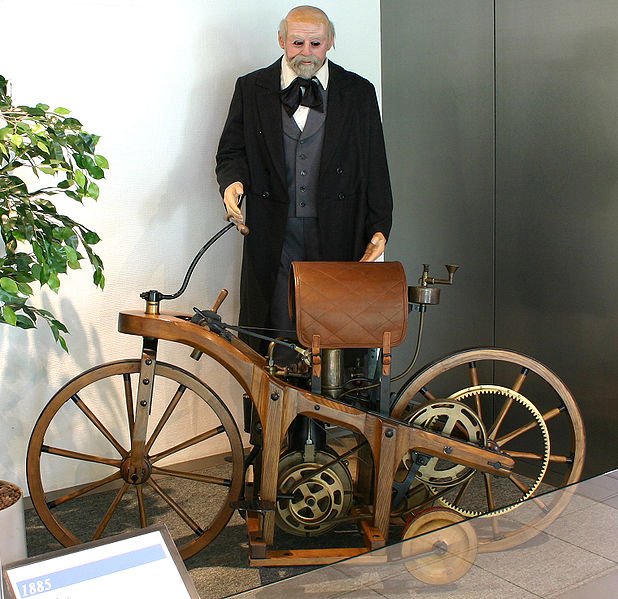
In 1898 a young man became intrigued by the newest gizmo - a bicyle with a motor!  This motorcycle was the hot new item.  Many young men tinkered in sheds and outbuildings to rig up their own contraptions.  The freedom, the speed, the fun!     

Invented in the late 1880's and early 1890's in France and Germany, especially the 1895 Damiler featured in many newspapers and magazines; it is believed many people attempted to create their own shadetree motorcycles inspired by the stories of these early attempts. The first American commercially produced motorcycle is said to have been  from the Orient-Aster, built by the Metz Company in Waltham, Massachusetts in 1898.  
Public domain - 1895  Daimler

On a hot August day in 1898, a brother and sister set off on a motorcycle and explored the curving roads and byways of Barry County, Missouri.  The thrills, the shrieks and the laughter echoed as the motocycle roared through the thick brush of the Ozark hills.  Granville Handford "Bud" Terry (21) and his younger sister Minerva Ardella Terry (17) apparently had an enjoyed time that  day  but  August 15, 1898 would end in tragedy for this brother and sister.


(Note: Minerva and Granville were my great aunt and uncle).

ACTOR DALE ROBERTSON HAD TIES TO OKC ELEMENTARY SCHOOL

Hollywood actor Dale Robertson was an alum of Eugene Field elementary school in Oklahoma City, according to numerous alums who gathered there in May of 1983 to say farewell to the old building.

This son of Oklahoma is dead at 89 but will live on for those who remember him on screen and off.

2/24/13

MORPHINE

In January of 1907, a young woman took a dose of morphine and a painful day later she was dead.  Rose Milton, 25, was an "inmate" (indicating she was probably working as a prostitute) of Maud Stewart's Place, 2 1/2 West California Avenue, Oklahoma City, Oklahoma.

The man with her,  unnamed, said she took the morphine at midnight on a Thursday and did not know the nature of the mixture until her suffering called attention to the situation.  Although doctors came to attend the woman, just before noon the next day she died. 

Related to opium and herion, morphine use has been suggested as early as ancient Rome.  Morphine is a highly addictive substance  made originally from the same poppy flower as opium  and was scientifically identified in the early 1800's.   It was a boon to individuals suffering from physical pain but its addictive elements produced an unforeseen side affect if dependence in some people. In 1849 a 'soothing syrup' for infants was marketed containing morphone called "Mrs. Winslow's Soothing Syrup."

A look at the self-help health care products may be a silent indicator that the "soldier's disease" of the Civil War era, a morphone addiction problem of U.S. soldiers wounded, while unverified may have been a reality.  One of the side affects of morphone addiction was constipation and the great number of ads for pills, elixers, and treatments of that condition do indicate this was a recognized problem of the era.  Kellogg of cereal fame was attempting to address this problem, among others, when he developed his healthy breakfast foods.  Although the condition is often linked to the nature of processed foods at the time, there may be another explanation since morphine was commonly available through drugstores and catalogs.  

The symptoms of withdrawl can also help interpret the actions of some individuals, such as Miss Milton. Many women of the day were stereotyped as having the vapors. Most assume this was caused by too tight corset lacing, and some can be attributed to that, but also a probable cause would be addiction to a morphine or a similar opium based drug.


The symptoms often mimiced the flu or similar illness: Sweating, Chills, Tearing eyes, Runny nose, Restlessness, Muscle aches, Backache, Dilated pupils, Irritability, Trouble sleeping, High blood pressure, Rapid heart rate, Vomiting, Diarrhea, Stomach cramps.

Miss Milton was said to be having an attack of "the blues" before she took that last fatal dose of morphine.  After a dose a person often became short of breath, their breathing slowed, and they began vomiting.  Once taken death could easily come from any one of the symptoms that included rapid heart beat, low blood pressure, confusion, dizziness hampering normal body and cognitive functions.  Fatal errors of judgement could mean death in many occupations and long term  use was detrimental to the strength of the heart.  

The pure food act of 1905 helped remove many toxic additives to milk and canned goods, but the purity or quality of medicines took a little longer to correct.  Too late for many, many people, like Miss Rose Milton who died in a sporting house in Oklahoma City in 1907 at age 25.


2/11/13

Undiscovered Country

Woodward Museum


"Archaeological surveys for highway construction near Mooreland in the 1950s exposed the Hedding Site and the Richards Site, both with evidence of habitation and house construction that may date from time of the Late Prehistoric Plains Village farmers in western Oklahoma, A.D. 800 to 1400. "


At the delightful Woodward Museum is a topographical map marking prehistoric history of the area. Along Doe Creek could be found the Hedding Site mentionde above and dated to about A.D. (C.E.) 1450 and further east the Loomis cemetery site dated to about A.D. (C.E.) 1200.

It is a fascinating reminder that other cultures lived in this land for thousands of  years before other people traveled inland from the eastern coasts.  The land in this part of Oklahoma may be plain, flat, and a little dull for some people, it has a fascinating history filled with wonder and mystery.  What were the stories of those sites? The adventures and the hardships?


1/23/13

Old Zulu : Martha Fleming

Artist rendering of Martha Fleming
by Marilyn A. Hudson, 2015.
She stood 6 feet tall; had a low and strong voice;
was a leader in the early
African American community
as business woman,
community activist and colorful character.

Her name was Martha Fleming, but every one called her "Old Zulu", and she ran the prostitution in African-American Oklahoma City until about 1909. Born in Virginia, there is little known about this woman other than the sometimes slanted accounts reported in local news articles and court records. She is profiled, again with a biased brush, in McGill's early, agenda-driven, account of the rough and rowdy early days of Oklahoma City.  She apparently was the dominant figure who kept the girls on "Alabaster Row" (believed to be the local brothels catering to African American men located on California Street) in line, operated in her own establishment or area outside of the city limits, east of the railroad tracks on Grand Ave. (Now Sheridan).

"Zulu" or "Zoo",as she was sometimes called, seems to emerge in the early days of the town.  She was believed to be a either a pawn or a collaborator of a much reviled Madame "Big Anne" (Anne Wynn Bailey). Thus she is seen as either a link to the African American vice and the money that could be made there or as mirror professional who functioned in the segregated reality of the times. Whichever was the truth, together, they managed a sizeable portion of the action to be found in Oklahoma City's "Hell's Half Acre." Her regular domain, the area of east Grand, just past the Santa Fe Depot may have been used by a variety of individuals for multiple purposes. The area, just after the run and for a long time later, was outside of town limits and thus beyond the sometimes inept or political motivated city police force.

The south side of "Hell" was called "Alabaster Row" and it generally assumed this was a line of establishments with African-American or non-white women. This may be true in full or in part.  Not enough objective evidence has been seen by this writer yet to define it strictly along those lines.  It is known, from establishments and writings from other locations (Leadville and San Francisco, etc.) that 'alabaster' was sometimes a term used to describe these women of the night. They were sometimes likened to marble statues of loveliness and perfection. There could have been a little of both involved here. It does seem strange that such a line of houses would exist on California to the south and most identify "Old Zulu's" domain as the E. Grand Ave. area across the tracks. It may be there were two groups catering to altogether different clienteles.  Many of the gambling, drinking, or carousing dens in "Hell" were a broad spectrum selection. Low dives rubbed shoulders with fine Belgian carpets and cheap 'rot-gut' was just across the street from full bodied wines of the finest label. The outside of town places may have catered to individuals who could not afford to come into town, for economic, comfort,  or recognition reasons.
 
Most newspaper and early descriptions seem to agree that Martha was a tall woman of tremendous strength.  She stood approximately 6 feet. She always carried a pistol on her and usually down her dress.  She sometimes wore a jacket and work boots.    She appeared to be many things from petty thief, to drunk, to drug user, political activist, and con artist. What ever she might have become, her Achille's heel was clearly an addiction. She was known to get a little energetic while under the influence of liqueur or heroin/cocaine. One instance, it took several full grown police officers to get her to the tank to sleep off her over indulgence and she tore up the jail and wounded another prisoner before she finally came down from the high of the stimulant.

Descriptions of these women can prove as fascinating and insightful as a photograph.  "Big Annie" was drawn in local papers as a fleshy, mean-faced, man-like woman used to pushing her weight around to keep control in Oklahoma City.  Social attitudes are apparent in the artistic renderings of her during a famous legal contest in 1908.  Likewise, social attitudes are prevelant in the label given Martha, she was tall, powerful, and wild.  Unrest in Africa at the time provided a new vocabulary as the Zulu army battled European armies for dominance.   She was then the archetypal savage black woman, "Old Zulu."  In both instances, part of the problem was they were women operating out of the acceptable boundaries of society, women acting indepently and  having some level of success. Lessor issues had to do with race and addictive behaviors aligned with preceptions of social status. In both women society had outcasts due to the work they did and so less focus was on the race of either woman.

Early Baptism in Canadian River
Both woman were apparently successful (if gauged by length of time they worked in Oklahoma City) in their line of work.  Both women apparently had connections within their social spheres and some degree of influence (although it is unknown if this influence was always legal ; blackmail could have been a tool used by both women).  This, however, was the life society allowed these women who operated outside the law but whose presence was often accepted as a social necessity.  

She was a regular visitor to the city lockup and had one of the longer arrest records in city history.  At one point, she was sent to jail (1895 and to Lansing in Kansas in 1906). Local law may have just grown tired of the swinging door of her pattern of misconduct.  

In 1907,  she was converted in a service conducted by the mission  housed where the notorious old "Blue Front Saloon" had operated. This was no doubt the holiness-pentecostal mission led by Harry Lott that became one of the first Pentecostal churches west of the Mississippi.

Like "Big Annie", "Old Zulu", is a rare and unique piece of the puzzle that is Oklahoma City history. Without all the history - the warts and the tiaras - the story is just not complete. The reality of addiction (sex, liquer, and drugs) is often overlooked when examining behavior of people in certain historic eras. In the middle of the Victorian-Edwardian period such behaviors were viewed as moral weaknesses of the lower classes. No  leeway  was given for addiction problems, life stresses, or social dynamics. 

Who was this early business woman of Oklahoma City? Where did she come from, what struggles did she have, and what happened to her after this brief window of time?  

The women like Annie and Zulu could be marginalized, scorned, jailed, and preached about - but they could not be ignored. People might not have liked the businesses they conducted but they were definitely some of the earliest women in any business in the early days of "Hell's Half Acre." 

--Marilyn A. Hudson (c)
NOTE: If you are a descendent of this woman, I would love to hear from you and share her story in more detail. Contact me at marilynahudsonATyahoo.com

1/18/13

St. Luke's Hospital, Wellington, Kansas

Personal collection of M.A.Hudson
The original hospital opened about 1910 and was sponsored by the Episcopal church.   In the 1920's a larger facility was built and was added to and finally torn down and a new faciluty built there. Today the hospital lives on as part of the Sumner County Medical Center.   Wellington, like many communities, changed vastly from its early foundings to its current form.  I called this location home for all of my life til I was about twenty, yet I never knew the majority of the town had been destroyed in a tornado in the early years. Huge buildings had once dotted its cityscape and fine homes had been built, destroyed, forgotten, and simply not spoken for decades. I think of this when someone decries some conspiracy theory saying no one could keep a secret for very long.   Yes they can.

1/16/13

The Dance of Death : An E.T. Connection?

close-up of figure
In the 1860's a surprising mural was revealed during renovations at Totentanz von St. Marien in Berlin, Germany.  Known as The Dance of Death, the illustrations are part of a 22 foot long mural and are very interesting in light of what is seen as a 20th century phenomenon, the extra terrestrial or E.T.

The nude figures with the lack of facial features (eyes, nose, mouth but that is all) are considered by most to be a personification of death. It was probably done in the late 1400's. It indicates that the large headed blank faced creature of modern myth may be a reflection of a much older concept reflecting the ever present presence of death. Always near and always collecting souls.

Of course, ancient alien enthusiasts might suggest the commonality is based on a shared extra-terrestrial experience spanning the centuries and expressed differently by culture. Thus middle ages artists depicted them as tall, thin while modern societies depicted them as (mostly) short and pale.

A friend traveled to Europe, ran across this interesting find and brought it to my attention. I urge anyone to take the time to visit this fascinating church and learn more of its interesting history as revealed in these, and other, art works.  Learn more here.
Section of a poster

1/6/13

SW HAD SOME CRAZY CULTS


In 1904 Oklahoma City there was a strange sight that  met residents and visitors looked down South Broadway one chilly spring day. Marching casually up from Reno street, yet with a destination in mind, were two men, John Aiken and James Sharp, a woman, Melissa Sharp, and a 12 year old boy, Lee Sharp. 


Declaring himself "Adam God" Sharp would prove an interesting character. What was really unusual about this incident was they were all stark naked.

Arrested, charged with lunacy, and ordered out of the state, they were back in 1906 in a cult community, Eden, in south Oklahoma county.

A few years later, 1908, the group (which now included a second in command, Louis Pratt) had gone to Kansas City.  There, they had caused a riot where five people died.   Sharp, and possibly his wife and others, were ordered to prison for his role in the riot.

The group have been a part of the Morman faith or confiscated some of the terms and teachings of the "Adam God" doctrine of Brigham Young, mixed in some extreme evangelical elements and bits and pieces of a lot of things. Not much has been found explaining the doctrinal aspects of this strange cult but it is clear that they were considered bizarre and out of the ordinary.  For most people in the Edwardian era, amusements were where they could be found and a group marching naked down a main city street had to have been worth a chuckle or two.  

Sources:
Oklahoman
NY Times
NY Times

1/2/13

A WELL REGULATED MILITIA

Ripped straight from today's headlines! Isn't that the way the old movie promos went?  "A well regulated Militia, being necessary to the security of a free State, the right of the people to keep and bear Arms, shall not be infringed." (Second Amendment of the US Constitution)

We hear a lot of discussion about changing this clause, about its outdated nature and how it conflicts with a modern ethos of society.  George Washington realized one brutal truth of political and social structures and that it is capable of great evil: "Government is not reason; it is not eloquence. It is force. And force, like fire, is a dangerous servant and a fearful master."   The Bill of Rights and those amendments were intentionally created to act as a buffer to protect the people from that fearful potential of any government to be a dire master.

In the second amendment guarantee of the right to bear arms the argument is often that there is no need for this since we have a military, we have a national guard,  and we have police.

We interpret militia in terms of radical extremism and potential terrorism. Instead it was neighbor with neighbor in time of need.  I would argue anytime people come to the aid of other people they are serving as a militia.  Not all battles involve bullets.

In historical research, however, it is necessary to look at things in their context.  How did those signers of the documents of freedom understand the term militia?

The term militia is derived from an abstract Latin noun and its recognized definition has been an army composed of ordinary - not military professional- citizens. It was the ability of the individual to be the army which was sought in such situations.  They were not fretfully waiting for someone to come to their rescue or their aide. They were not expecting some vague 'someone else' to defend their land, liberty, property, life, and sacred honor.

The idea dates back to early Anglo-Saxon days but the term may date back to only the late 1600's.  It was expected that every able bodied man would be able to pick up his weapon and rush to the aid of King and Country in the event of national emergency such as an invasion or hostile takeover.

The militia of the colonial period was crucial to protect the citizens of an area from hostile encounters of any type ranging from hostile Native tribes, invading armies, or other groups bent on hostilities.  The British army was far away, sometimes too far away to arrive in time to assist, and so locally prepared individuals were a must.  The British depended as much on these locally armed individuals as much as the settlements did.  

Remember communication was slow and a call for help might be answered too late.  Were none armed a clear and easy path to major settlements, supplies, and control of the colonies would have been presented to any hostile force intent on takeover.

Add to the dangers mentioned over time of a threat from the British government itself.   As tensions between British rule and colonial life began to heighten.  As the British raised taxes repeatedly.  As they refused to listen to complaints or grievances.   As they refused any representation of the Colonials in the rules and decision making process.  As Colonials were forced to open their homes to board officers   Forced to share their limited food and supplies whenever a passing British army troop wanted. They were stressed to make enough to pay the increasing taxes and keep their homes, farms, and businesses afloat. 


James Madison said : "A well regulated militia, composed of the body of the people, trained in arms, is the best most natural defense of a free country. "

John Adams said : "The fundamental law of the militia is, that it be created, directed and commanded by the laws, and ever for the support of the laws."

Benjamin Franklin said :  "Any people that would give up liberty for a little temporary safety deserves neither liberty nor safety."

John Adams said:  "Our constitution was made only for a moral and religious people. It is wholly inadequate to the government of any other."

"Laws that forbid the carrying of arms... disarm only those who are neither inclined nor determined to commit crimes... Such laws make things worse for the assaulted and better for the assailants; they serve rather to encourage than to prevent homicides, for an unarmed man may be attacked with greater confidence than an armed man.   Jefferson's "Commonplace Book," 1774_1776, quoting from On Crimes and Punishment, by criminologist Cesare Beccaria, 1764


Patrick Henry said, "The Constitution is not an instrument for the government to restrain the people, it is an instrument for the people to restrain the government."

A people ignorant of their history are always doomed to repeat the mistakes of their past. (mah)

Given the reality of the government becoming an absolute entity that corrupts absolutely, and the downward spiral of the abusive government seen in the Colonial period rising once more, and the need emerging to protect body, property and family from the forces unleashed in such a setting, is there not still the potential need for a militia?  Especially a militia defined as the prepared, armed and capable individual?  

As to the arguments.

We do not need a militia because we have the military.  The military are professional soldiers under the direction of the government and the law. If such a group, like the British government under King George or the military under Hitler, abuse that privilege and ignore the law, what is the recourse of the individual? If an outside force invaded or the standing military was decimated, what then? Heller has observed that anytime the rights of the people are mentioned int he Constitution it is predicated on the individual.  To paraphrase, "who you gonna call?" A group, a militia, a social anything is always comprised of individuals.


Militias are all just extremists, terrorists and radicals.  Sometimes that is the case, in some rare instances in the Civil War the militias, or state volunteers, disintegrated into marauders under poor leadership. Radical extremists with agendas of hate and terror have emerged. Sometimes there have also been periods when government failed to be the best it could be and devolved into something less than it should have been.  Like Washington noted, government is force and Madsion noted the Constitution was for moral people; sometimes our government and morality have been strangers.  The result was always a time of shame. No one calls for the eradication of the government though and so it must be recognized that there are these 'blips' sometimes.  Course corrections to realign the national moral compass are needed and we go on, hopefully having learned something along the way.

It is a complex issue, made more so by highly charged emotional, political, and social forces at work in the discussion.  Let us hope there is discussion and we do not devolve into shouting, vilifying  and exclusion.  Let us hope, also, that we do not throw the Constitutional baby out with the muddied waters of this highly charged topic.

Read more at
http://www.brainyquote.com/quotes/keywords/militia.html#hGt8lGgEJ349eXAe.99
http://www.dojgov.net/Liberty_Watch.htm


I Write Like...

I write like
H. P. Lovecraft

I Write Like. Analyze your writing!

Expanded and Revised Edition

Expanded and Revised Edition
Coming Soon!